
Corporate Plan 2022–23
On this page
Department of Finance
Download the Corporate Plan 2022–23 [PDF, 2.02Mb]
Download the Plan at a glance [PDF, 2.02Mb]
Covering reporting period 2022–23 to 2025–26
Message from the Secretary
Link copied The Department of Finance's Corporate Plan 2022–23 is released at a time when Australia continues to manage the COVID-19 pandemic and faces a range of ongoing economic and broader challenges that are affecting the lives of many Australians. Finance continues to play a leading role in supporting government to respond to these challenges and implement its priorities.
Our purpose is to assist the Government to achieve its fiscal and policy objectives by advising on expenditure, providing effective governance and stewardship of public sector resourcing and reporting, driving public sector transformation, and delivering efficient, cost-effective services to, and for, government. This corporate plan sets out how we will achieve our purpose and assist the new Government to deliver on its commitments.
We will deliver a wide range of significant initiatives over the next year. These will include preparing and delivering the Budget and related economic and fiscal updates, assisting agencies with major transactions and the establishment of new investment funds, uplifting data and digital capability across the Australian Public Service (APS), and enhancing the governance frameworks for Government Business Enterprises (GBEs). We will also continue to enhance whole-of-government frameworks in areas such as grants, procurement and risk management, to ensure they are robust and uphold the principles of accountability and transparency. Continuing to progress the shared services transformation, efficiently delivering a range of services to agencies and the parliament and implementing the Government's public service-related net zero commitments are also priorities.
Building strong, collaborative relationships is crucial to our effectiveness. In collaboration with the Treasury, Finance will support the Government to conduct the audit of wasteful spending, and review Commonwealth expenditure to identify opportunities to improve the quality of Government spending. Through our work with the Australian Electoral Commission, we will support the Government in progressing the referendum to enshrine a Voice to Parliament in the Constitution. We will be working with a range of agencies to support the implementation of the Government' Buy Australian Plan commitment, including by increasing the opportunities for Australian business participation in government procurement opportunities.
Progressing public sector reform and transformation continues to be a priority for Finance and is a key focus of the Government. The Department of the Prime Minister and Cabinet and the Australian Public Service Commission are key agencies that Finance will partner with to progress these reforms. Finance will play a critical part in implementing the Government's response to the recommendations of Set the Standard: Report on the Independent Review into Commonwealth Parliamentary Workplaces (2021) given its responsibilities to members of parliament and their staff.
To operate effectively, we need to continue to invest in our capability – in our people, our systems and our practices. Our people, in particular, are the key to our performance. We continue to refresh our strategies to attract, build and retain the talent and skills we need; embrace data, technology and flexible and responsive workforce models; and strengthen leadership and a commitment to integrity throughout the organisation.
I would like to acknowledge the outstanding work of my predecessor, Rosemary Huxtable PSM, who led Finance for the past 6 years, demonstrating its adaptability and effectiveness in assisting government during this particularly challenging period.
I look forward to the challenging work of the next several years and am pleased to present the Department of Finance Corporate Plan 2022–23.
Jenny Wilkinson PSM
Secretary, Department of Finance
Introduction
Link copiedI, Jenny Wilkinson, as the accountable authority of the Department of Finance, present the Department of Finance Corporate Plan 2022–23 for the period 2022–23 to 2025–26, as required under section 35(1)(b) of the Public Governance, Performance and Accountability Act 2013 (PGPA Act).
Purpose
Finance assists the Australian Government to achieve its fiscal and policy objectives by advising on expenditure, managing sustainable public sector resourcing, driving public sector transformation and delivering efficient, cost-effective services to, and for, government.
Integrated performance cycle
Finance's integrated performance cycle aligns with the Corporate Plan. The Corporate Plan is our principal planning document and sets out how we manage our responsibilities and use of public resources. Performance planning occurs through regular budgeting processes, the Portfolio Budget Statements (PBS), and performance reporting in the Annual Report. Integrated business planning and governance processes direct individual and team activities to achieve our purpose and create a clear line of sight between Finance’s strategic and operational business planning. Figure 1 illustrates the relationship between this performance cycle and our operating environment.
Figure 1: Finance's performance cycle and environment

Operating context
Link copiedFinance has a key role in providing advice and frameworks to support entities across the APS to achieve their objectives, to improve outcomes for the Government and the Australian community.
As a central agency, Finance assists government to meet its outcomes across a wide range of policy areas. We deliver our work through 3 performance themes:
- Advising on expenditure
- Public sector resourcing and transformation
- Delivering services to, and for, government.
The events of the last few years have transformed the operating environment of the APS. The pandemic, the bushfires and floods, and the challenging strategic international environment have presented risks that have required changes to the way in which the APS operates. To effectively assist the Government to manage these challenging circumstances, the APS has needed to demonstrate its ability to be flexible and resilient, and to respond to rapidly changing priorities. In an unpredictable environment, a willing, flexible and connected public service has been an asset to government and the community.
Finance has played a key role in assisting the Government during this period and has needed to continue to adapt and learn. We have encouraged the adoption of digitally-driven solutions and innovation in the way we work. We have continued to review our practices, processes and procedures to ensure our operating model focuses on automating the more routine aspects of our work, releasing capacity for our staff to apply their expertise in ways that add the most value. We have focused on strengthening our strategic and cooperative partnerships, maturing how we mobilise resources to priorities and collaborate across the Department and the APS.
Finance's enabling functions in relation to people, financial management, facilities, business continuity and optimisation, and information and communications technology are central to our performance. Our governance framework, led by the Executive Board, facilitates sound, transparent and timely decision-making and enables us to respond quickly to emerging challenges.
The recent change of government brings with it changes in focus and priorities. Finance will continue to play a key role in delivering services to government, implementing the commitments we are responsible for, and supporting entities to deliver on the Government's priorities.
Environment
In an environment of complexity, uncertainty and change, it is more important than ever that the Department is well equipped to support the Government, including by applying the lessons learned from responding to recent challenges. Table 1 sets out the environmental factors that may affect our ability to achieve our purpose across our 3 performance themes.
Table 1: Environmental factors 2022–23 to 2025–26
| Environmental Factors | Controls |
| Advising on expenditure | |
|
Global and domestic uncertainty and volatility, requiring budget and policy responses and decision-making to occur in a dynamic and rapidly changing environment. Ongoing pressure to: balance short-, medium- and long-term fiscal and policy objectives; manage issues influencing Australia's social, economic and demographic trends; and protect the structural integrity of the Budget. |
Finance is continuing its investments to support rapid and evidence-based budget and policy responses, including enhancements to systems, data analysis, our workforce, and process automation. Finance will enable Commonwealth entities to access their appropriations on a near real-time basis, increasing government efficiency and reducing business continuity risk for Commonwealth cash management. Finance will collaborate closely with entities to review budget estimates, and update budget estimates to take account of the best available information and to maximise reliability and accuracy. As part of this work, Finance will continue to apply rigour and discipline to fiscal and policy advice provided to government by leveraging policy expertise, data, analytics and modelling. |
| Public sector resourcing and transformation | |
| Australian Government-owned GBEs need to adapt and change to meet community expectations. | Finance works closely with partner shareholder departments in supporting ministers and engaging with GBE Boards and senior executive teams. Finance will continue to provide advice on accountability and governance arrangements, board appointments and GBE performance and financial sustainability. |
| Australian Government agencies need to harness the benefits of data and manage associated risks. | Finance works across agencies, state and territory governments and more broadly to address systemic barriers to data management, sharing and use. |
| Citizen and business expectations of access to high-quality services, delivered in real-time and at low cost. |
Finance will continue exploring opportunities to leverage automation and digitally-driven solutions to streamline our processes, focusing on the most valuable aspects of our work and placing clients at the centre of our service delivery solutions. Finance's stewardship role in leading, facilitating and implementing whole-of-government public sector reforms and transformation initiatives is critically important. We will continue to review whole-of-government policies and frameworks, increase our engagement to build knowledge and understanding of these frameworks, and strengthen our relationships and engagement with strategic partners. |
| The ongoing drive from government and the public to achieve transparency within the public sector. |
The Transparency Portal (the portal) is the central source of data and corporate information included in Commonwealth entity and company annual reports, providing ease of access to this data and information for the parliament and the public. The portal, which has operated since 2018, presents annual reports in a digital form, allowing data to be readily accessed and analysed, including comparative analysis over time and across entities and companies. Work is now underway to include entity and company corporate plans and PBSs in a digital form on the portal. Combined with the digital annual report, this will provide access to a broader set of corporate and budget data and information, and will allow for a 'clear read' across these key accountability documents. |
| A challenging environment in relation to the level of insurable risks, driven by factors including significant weather events, a rise in class action litigation, general insurance market hardening, and the increasing complexity of government activity. |
Finance's continued investment in building capability in financial and policy advice ensures the advice and support we provide meet expectations and reflect best practice. Finance will conduct regular actuarial assessments and valuations. We will also deliver the Comcover Education Program, designed to increase risk management capability across the Commonwealth. |
| Citizen and business expectations of government action on climate change. | Finance will lead implementation of the Government's commitment to reduce the APS's emissions to net zero by 2030 (excluding security agencies). This includes the low-emissions vehicle target for the Commonwealth fleet of 75% of new purchases and leases by 2025, and supporting transparency by reinstating annual public reporting of Commonwealth emissions. Finance is working with agencies to develop the whole-of-government net zero policy and reporting framework and to build cross-agency capability in this area. This complements related work being led by the Department of Climate Change, Energy, the Environment and Water, and the Department of the Treasury. |
| Delivering effective services to, and for, government | |
| The community's expectations regarding the management of expenses for parliamentarians. | In 2022, Finance delivered expanded office and HR functionality as part of the Parliamentary Expenses Management System (PEMS). PEMS is modernising and streamlining the management, processing, audit, and reporting of expenses for parliamentarians and their staff. We will continue to support the adoption of modernised services for clients (PEMS, COMCAR Automated Reservation System, (CARS)) over the period of this Corporate Plan. |
| Public sector operations changing due to COVID-19. | We will continue to expand and increase the use of common enabling tools and technology to support greater connection and collaboration across the public sector. This is particularly important for a flexible workforce. Regular reviews of and refinements to Finance's digital working tools will ensure the support mechanisms for managers and staff remain fit for purpose. |
Risk oversight and management
Finance recognises that positive engagement with risk is a key contributor to innovation, improved productivity and performance. We acknowledge the importance of a strong 'tone from the top', complemented by a culture that values individual capability and accountability and supports meaningful communication and information flows throughout our organisational structure.
Finance's Executive Board, chaired by the Secretary, has overarching responsibility for the framework. The Executive Board monitors our strategic risks and determines the Department's risk appetite. The Chief Risk Officer, a central risk oversight team, the Risk Subcommittee, and the Audit Committee support the Executive Board in reviewing and assuring the appropriateness of our systems of risk oversight and management.
Senior executives are responsible for the management of risks that may affect corporate objectives. These risks are closely monitored and reported to ensure a clear line of sight between day-to-day risk management and our key strategic and operational risks.
Finance also supports the Minister for Finance in her responsibility for oversight of whole-of-government risks, including those notified through corporate planning, advised by GBEs under section 19 of the PGPA Act, or arising in relation to the management of insurance risks.
Risk appetite
We articulate our appetite for engaging with opportunity and risk through a risk appetite statement:
“To meet the Australian Government's fiscal and policy objectives, the Department of Finance carefully considers risks and opportunities in our complex and changing operating environment.
Finance recognises it cannot, and should not, eliminate all risk in delivering on our purpose. Considering opportunities to innovate, as well as managing risk, allows us to drive transformative change within our own department and across the public sector. Our appetite for engaging with opportunity and risk extends to the management of shared risks with other entities to deliver on the Government's objectives.
Finance's risk appetite informs and guides our decision-making and plays a central role in shaping a culture that embraces change and innovation while promoting the effective and efficient management of public resources.”
Key strategic risks
Finance has identified 9 key strategic risks that, were they to eventuate, would affect our ability to achieve our purpose.
Table 2: Key strategic risks and mitigation strategies
| Strategic risk | Risk mitigation strategy |
|
Finance's central agency role involves strategic and cooperative partnerships with other government departments and a broad range of stakeholders to support the provision of well-informed and well-considered advice. To strengthen these partnerships, our governance structures are regularly reviewed to ensure our decision-making remains collaborative and focused on effectively managing shared risks. Our partnered and collaborative approach is all the more critical as the Department provides rapid advice in a highly uncertain environment. |
|
Finance will strengthen our cooperative partnerships with other government agencies to identify shared risks, share lessons learned and jointly develop solutions with a focus on shared risk outcomes. This collaborative approach will ensure the Department is effective in driving transformation in a changing environment. |
|
As part of our governance structure, the Major Investments Committee plays an important role in providing oversight, advice, and assurance over Finance's high-risk projects and investments. Finance's Audit and Risk committees continue to provide independent advice to the Executive. |
|
Finance's governance committees play a role in connecting operations across the Department and enabling timely, evidence-informed decision making. Finance's ICT strategy, renewed in 2022, continues to drive enhancements that enable staff to operate effectively in connected and engaged teams when working flexibly and from various locations across Australia. |
|
Finance collaborates internally and operates as a connected entity. Finance is systematically prioritising work and allocating resources through integrated processes that consider the Department's operating model and risk profile as part of a long-term investment approach. We continue to refine our approach to integrated business planning and committee governance, ensuring a clear line of sight between strategic and operational-level activities and decisions. |
|
Finance invests in people and culture through defined leadership behaviours and people management frameworks that focus on building capability and supporting mobilisation and flexibility in our working arrangements to ensure staff engagement at all levels. As part of our governance structure, the People Committee plays an important role in providing oversight, advice and assurance on the strategic direction for people management, leadership development and workforce capability within Finance. We have implemented our workforce strategy, ensuring the capability, capacity and composition of our workforce remains fit for purpose. |
|
We are developing a Health and Wellbeing Strategy to bring a more holistic, long-term focus to measures targeted to supporting staff wellbeing. As part of our governance structure, the People Committee plays an important role in providing oversight, advice and assurance on the strategic direction for people management, leadership development, and workforce capability within Finance. |
|
Finance optimises opportunities to deliver better programs and services, to enable outcomes that are fit for purpose. We value forward planning that anticipates the needs of our people and stakeholders – including shared risks with other entities to deliver on the Government’s objectives – and the Australian community. Finance continues to build awareness and maturity in benefits realisation and management, and how this is reflected in our approach to integrated business planning and performance reporting at all levels. |
|
We are strengthening our ability to govern and manage data by embedding new systems and practices that improve public sector policy advice and program delivery through enhanced data analytics and data management. Finance's Information and Data Governance Forum supports the Chief Information Governance Officer in building maturity in data governance and management. In 2021–22, we released our inaugural Data Strategy and 2022 Action Plan. The strategy sets out the key initiatives we will undertake that will support Finance in leveraging data as an enterprise to influence and enhance our advice to government, strengthen our stewardship role, improve service delivery, guide investment, and promote better management of data assets and capabilities. |
Capability and enablers
Link copiedThe quality of Finance's capabilities and enabling functions will influence how well we deliver on our purpose over the period of this Corporate Plan.
Figure 2: Finance's workforce composition
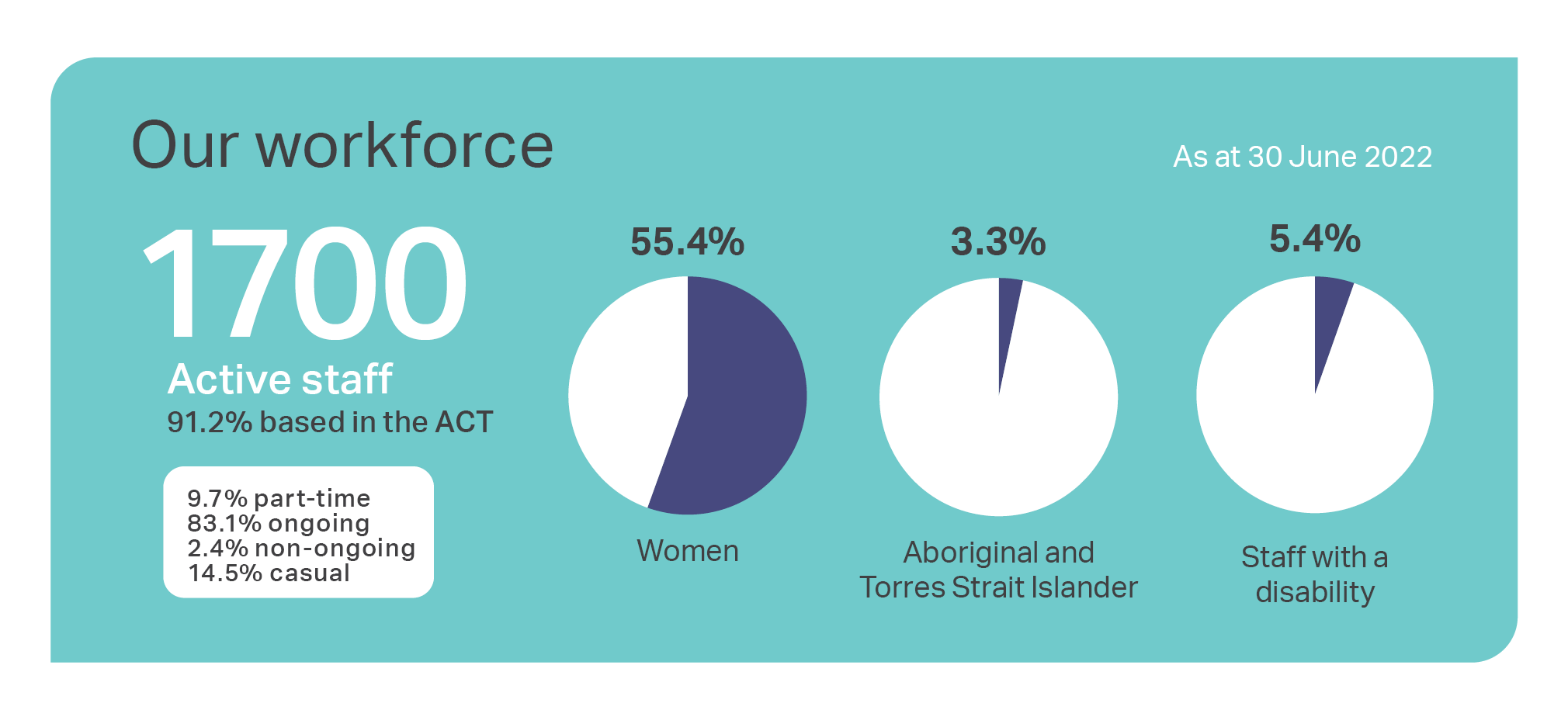
People
The Finance Workforce Strategy articulates our continuing focus on key workforce risks, including attracting and recruiting a capable workforce, enhancing leadership capability, building professional and critical skills and strengthening workplace practices that support engagement and retention.
Finance is committed to a flexible, inclusive and positive workforce culture, and values the diversity of our people. Diversity@Finance, Finance's Diversity, Inclusion and Belonging Strategy, aligns with APS-wide diversity plans. In parallel with our Reconciliation Action Plan (RAP), Diversity@Finance provides a strong platform to develop and strengthen our approaches to attract, recruit, develop and retain a diverse workforce. Finance's fifth RAP outlines our ongoing commitment to reconciliation, enhancing our cultural competence and increasing our awareness and support to Aboriginal and Torres Strait Islander peoples. The Department's Aboriginal and Torres Strait Islander Network continues to play an active role in providing advice, supporting staff and creating connections.
Our Health and Wellbeing Strategy, due to be released in 2022–23, will support the health and wellbeing of our people through education, awareness and communication. We continue to monitor, actively respond to and manage the COVID-19 pandemic to maintain staff health and safety.
We will develop an Employee Value Proposition (EVP) to be launched in 2022–23. The EVP will be a key feature in our attraction strategy and will assist Finance in establishing a strong brand as an 'employer of choice' in a challenging labour market. The EVP will feature across all recruitment campaigns and support the retention of existing departmental staff.
The Finance People Capability Framework outlines the core capabilities for staff across all classifications. Over the period of this Corporate Plan, Finance will explore opportunities to leverage digitally-driven solutions to innovate our learning approaches. Embedding capabilities in financial and policy analysis, data analytics and digital literacy will be a departmental focus.
We have established a set of leadership expectations and values considered essential to all roles in Finance. Delivering on leadership expectations is the responsibility of all staff, and forms part of our integrated performance framework.
Figure 3: Finance's leadership values
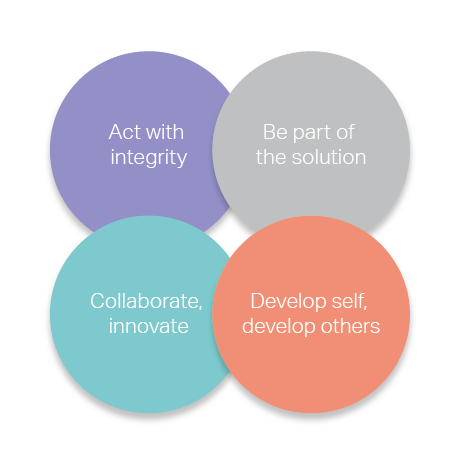
Integrity framework
"Finance is committed to a culture of professional integrity. We expect, empower and support our people to act with honesty, transparency and accountability at all times and all levels."
The public is entitled to expect high levels of integrity in the APS, including that delivery of outcomes is efficient, effective, economical and ethical. Our Integrity Framework sets integrity expectations for awareness, capability, and transparency. Staff are supported to access skills development and training to strengthen a culture of integrity and transparency and ensure a strong focus on the values of professionalism and a commitment to delivering quality work.
Business Optimisation
Finance's business optimisation function uses the latest available technology to provide fit-for-purpose digital solutions to all business areas by automating and streamlining tasks, releasing capacity for staff to focus on key value-add services. The key focus moving forward will continue to be on robotic process automation, workflows and reporting, building on the successful deployment of digital workers and reporting automations, which combined have returned 19,000 hours to the Department, enabling staff to focus on data analysis and business improvement.
Process automation and business process improvement build resilience by maturing Finance's service delivery to continuously meet the evolving challenges of the public sector. Over the period of this Corporate Plan, the business optimisation function will continue to drive the increase in process automation and the number of hours released back to business.
Data and information management
"As a central agency responsible for advising on government expenditure and resourcing, we will leverage our data as an enterprise to influence and enhance our advice to government, strengthen our stewardship role, and improve service delivery."
Figure 4: Finance's data and information management dimensions for success
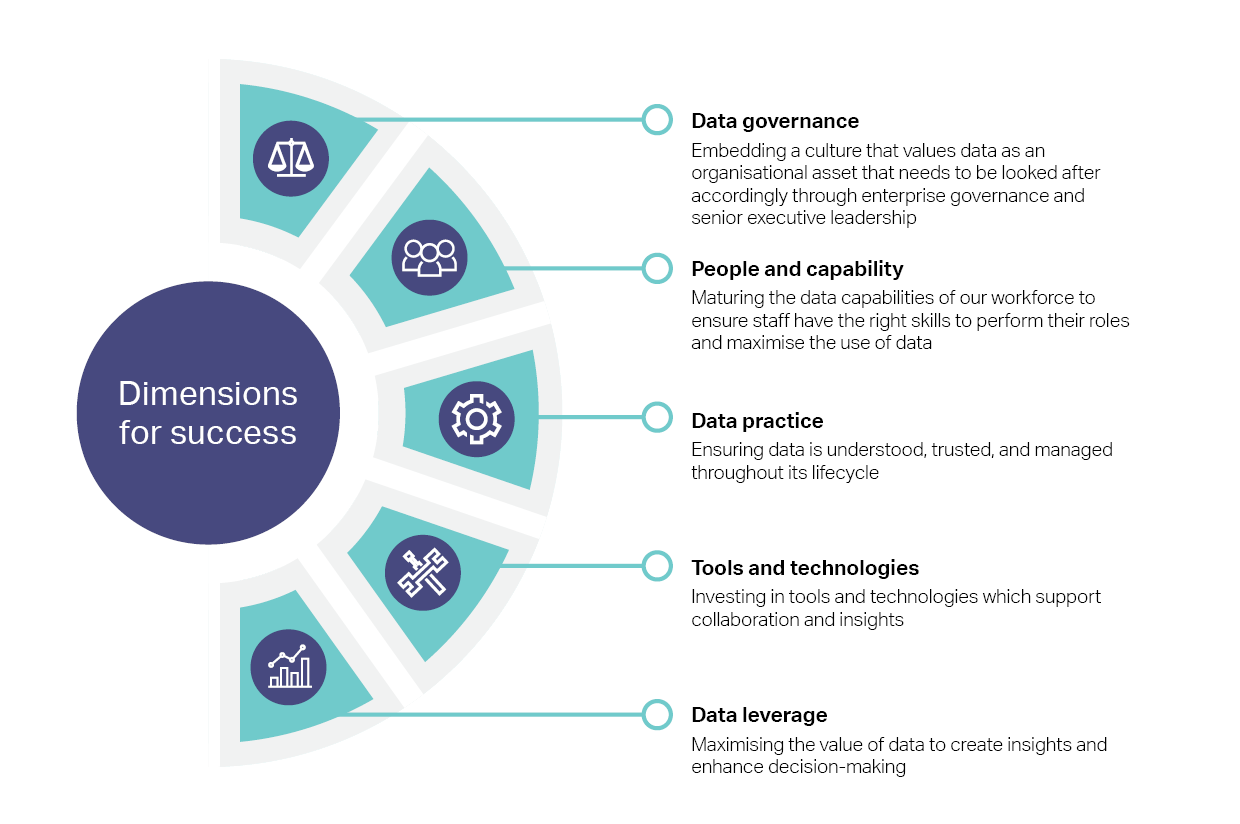
We are committed to improving our data and information management practices to enhance policy outcomes and support evidence-based decision-making at all levels. Our Data Strategy and 2022 Action Plan set out the key initiatives that will support Finance in leveraging data as an enterprise to influence and enhance our advice to government, strengthen our stewardship role, improve service delivery, guide investment, and promote better management of data assets and capabilities.
Information and communications technology
All Finance staff have access to a consistent IT platform as a result of the 'One Desktop' project. Use of common devices has made for a more agile environment and supported the successful transition to flexible working arrangements, including in response to COVID-19. Finance's GovTEAMS platform and videoconferencing functionality enables staff, and the APS more broadly, to continue to work effectively in connected and engaged teams when working remotely.
Our 2022–2025 ICT Strategy will deliver cost savings and greater flexibility in our work practices, operations, and storage requirements. The Finance Advanced Cloud Environment Transformation (FACET) project, to be finalised by late 2022, is moving the Finance ICT environment to the cloud to provide technology, skills and support that enable further digital transformation. FACET will provide robust, secure, resilient, and agile technologies that are easier to consume; access to innovations from a broad range of commercial providers; and enhanced inter-departmental collaboration and knowledge sharing.
Financial management
Finance has a total departmental expense budget of $663.4 million in 2022–23 including for functions delivered for whole-of-government purposes and supported through Special Accounts. Finance's departmental capital budget is $59.9 million, of which $47.8 million relates to projects in the Property Special Account.
Finance has a total administered expense budget of $11,666.8 million in 2022–23 and an administered capital budget of $17.9 million.
Further information regarding Finance's budget estimates (departmental and administered), Average Staffing Levels, and financial statements for the reporting period is set out in the Finance PBS 2022–23.
Figure 5: Total expenditure 2022–23
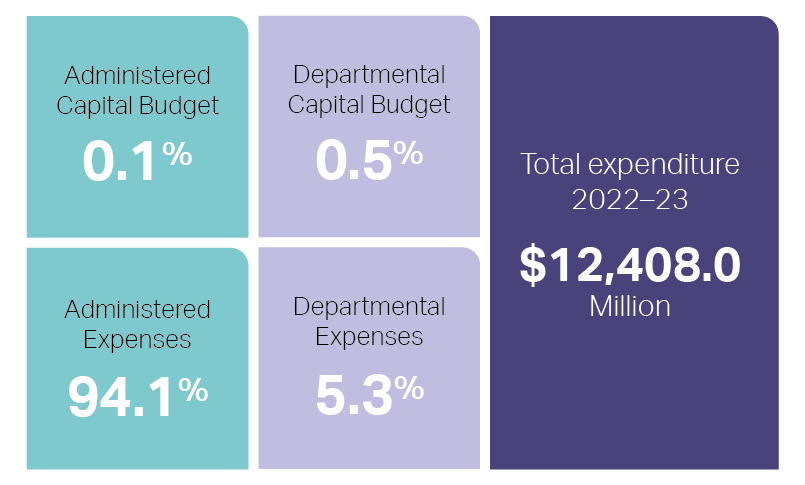
Governance and integrated business planning
Finance's governance framework promotes the principles of good governance and supports transparent performance in line with government and departmental priorities. Finance's governance framework is supported by a centralised secretariat function. This helps ensure decision-making on key issues is consistent across Finance, aligned with priorities and management of risk, and supports the Secretary in the discharge of duties under the PGPA Act and the Public Service Act 1999.
Figure 6: Finance Governance Framework
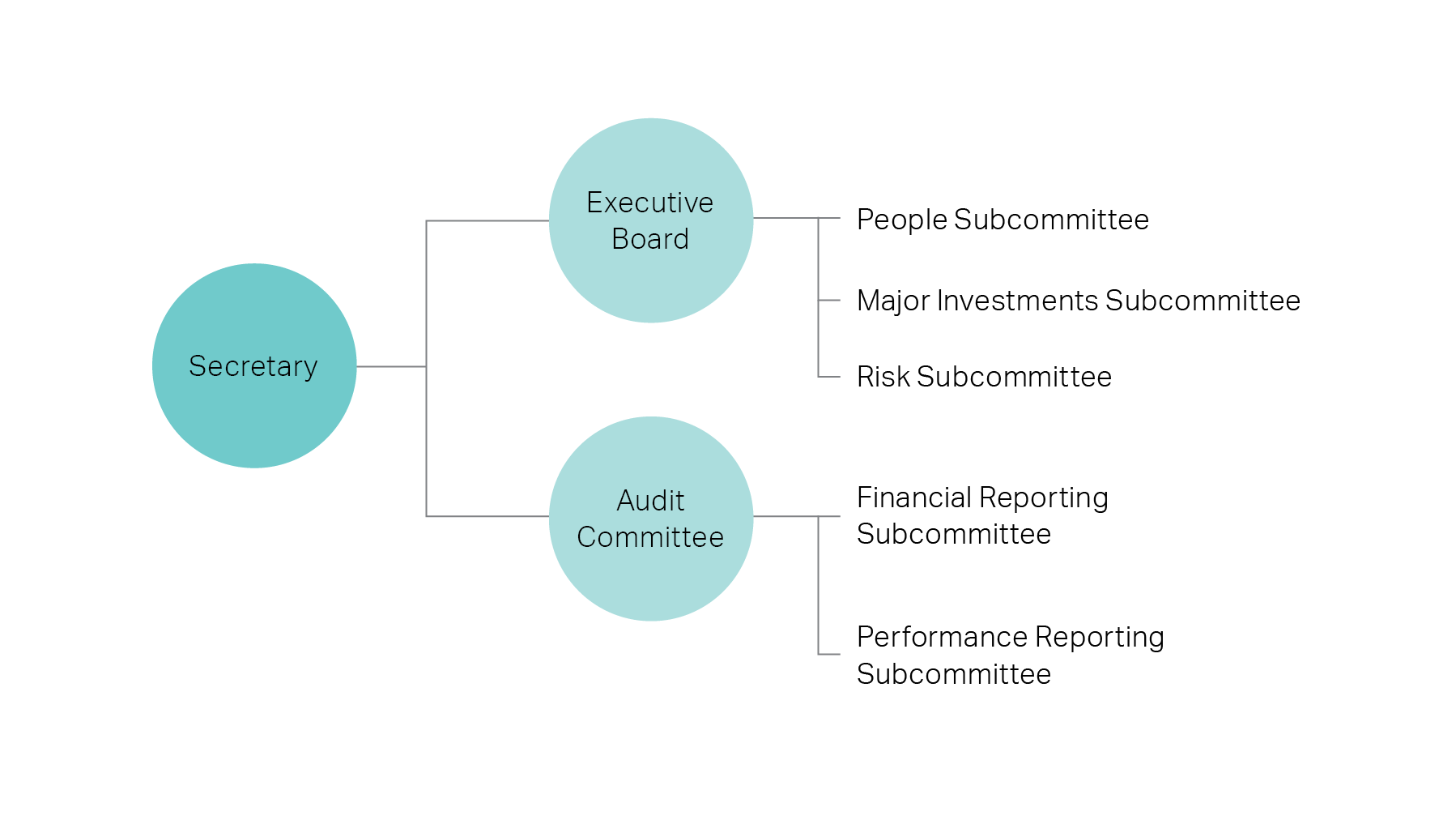
The Executive Board, supported by its subcommittees, has established and manages an integrated business planning approach to set departmental strategy and make decisions on departmental priorities and resourcing, aligned with Finance's approach to managing risk.
Strategic partnerships and cooperation
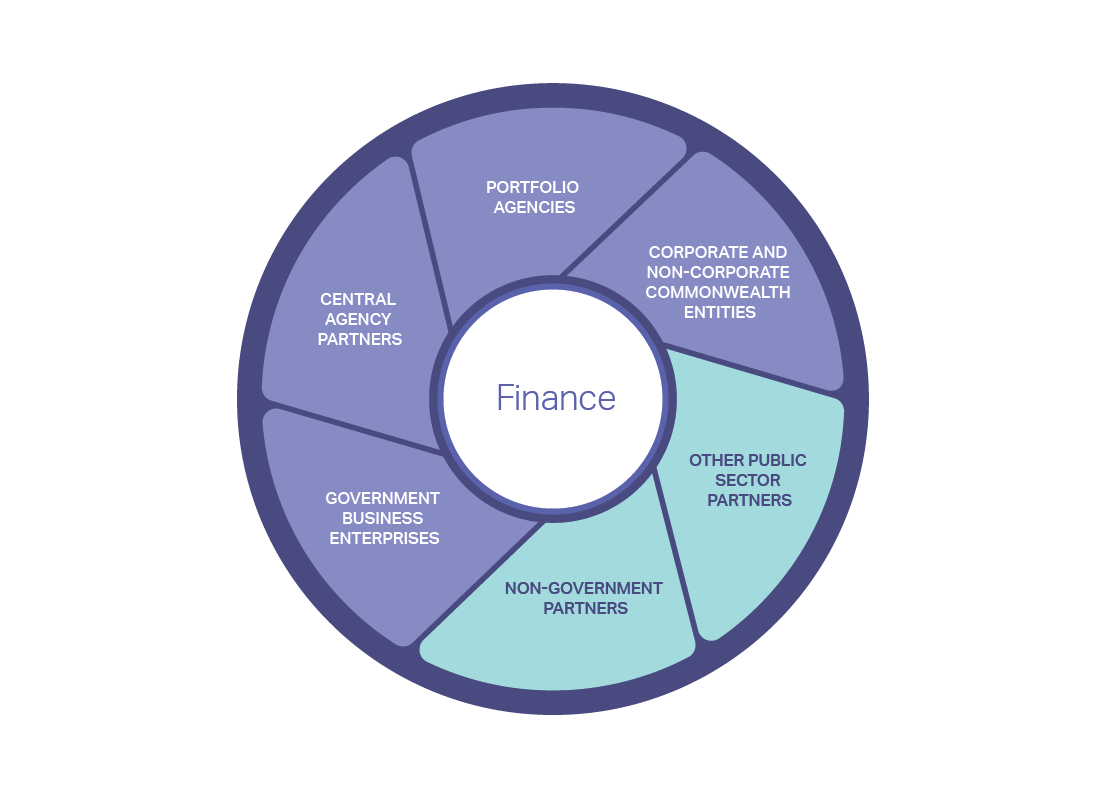
Underpinning Finance's contribution over the period of this Corporate Plan is the quality and strength of our relationships (Figure 7). We take a proactive role in collaborating with other government agencies to support a more effective, efficient and agile public service, achieving better outcomes for government.
Figure 7 provides an overview of some of the strategic partnerships and cooperative arrangements Finance uses at an entity level to achieve our purpose. As part of these arrangements, Finance:
- works with partners across the public sector including central agency partners, the Department of the Prime Minister and Cabinet and the Treasury, and with the Australian Public Service Commission (APSC) to provide leadership in the APS
- provides guidance and support on financial, regulatory, and policy advice, budget estimates and the Commonwealth's finances to entities across the Commonwealth including Corporate and Non-Corporate Commonwealth Entities
- supports our portfolio agencies to achieve their objectives by working together to deliver shared outcomes in accordance with the PBS. Finance collaborates on policy development and learns from our 'on the ground' experiences to continue refining frameworks for the future
- collaborates with other public sector partners, including state and territory governments to develop appropriate responses to enterprise-wide issues (cross-jurisdictional and cross-APS) related to the Budget, regulation, and emergency response
- works with non-government partners to challenge our thinking and test our ideas, and leverages industry expertise and better practice, thus helping us understand Finance's operating environment and develop policies and advice that support a fit-for-the-future public service
- works closely with joint shareholder departments in supporting ministers and engaging with Government Business Enterprise Boards and senior executive teams.
Further details regarding the Department's cooperative arrangements with specific entities and sectors that support Finance's key activities are presented in the performance sections.
Figure 7: Key strategic partnerships and cooperative arrangements
Performance
Link copiedWe are committed to strengthening the performance information provided to the parliament and the broader community.
Performance themes and framework
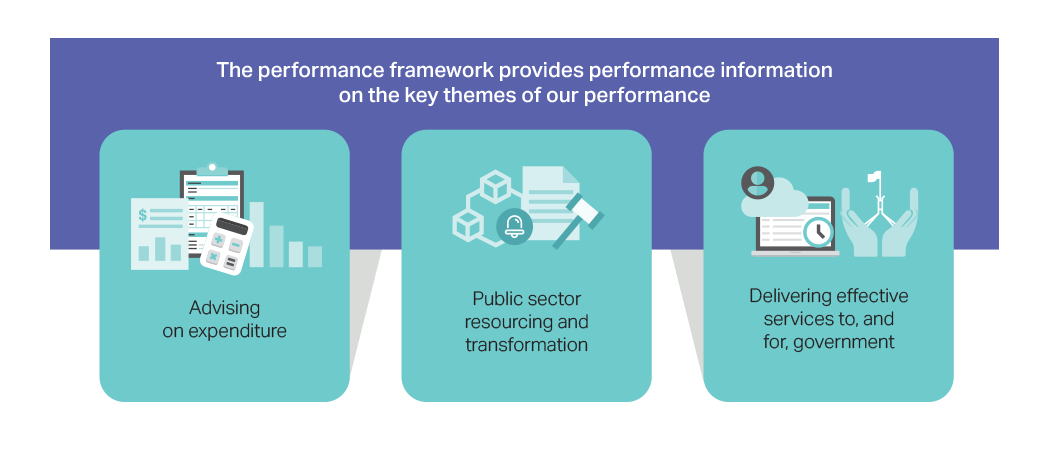
Finance's responsibilities under each performance theme are not mutually exclusive. Collaboration across functions remains a key feature of the way we work and allows us to offer integrated services for clients and partners. Collectively, our performance themes ensure all activities contribute to achieving our purpose.
Finance's performance framework (pages 18-41) provides substantial detail on how we measure progress in achieving our purpose by identifying:
- key activities under each of the 3 performance themes
- performance measures that reflect the outcomes these activities are intended to achieve
- goals for each performance measure to assess achievements over time including performance targets where reasonably practicable
- methodologies to monitor results and track overall progress.
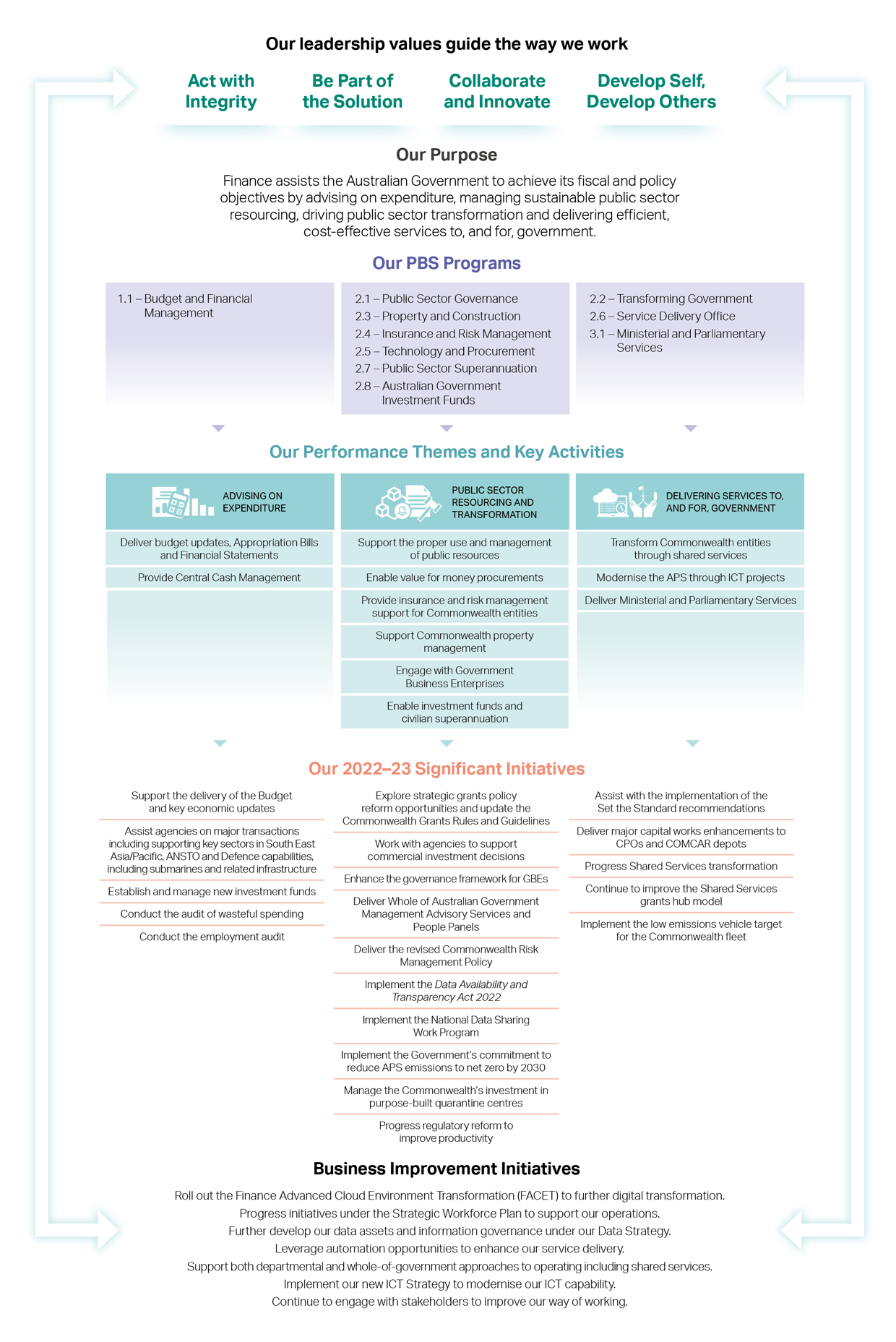
Figure 8 outlines the clear line of sight and relationship between Finance's different levels of business planning (the purpose statement, key activities, and significant initiatives) and how the approach we take is shaped by our values, guiding principles and commitment to business improvement.
Our key activities align with our current PBS programs and contribute to achieving our purpose statement. Our programs, key activities, purpose statement and performance measures will be reviewed following the release of our October 2022 PBS, which will incorporate July 2022 machinery-of-government changes affecting Finance and our partners. Updates to elements of our Corporate Plan will be made to reflect new responsibilities, shared risks and clear intended benefits over the short, medium and long term for our new responsibilities.
For completeness, Finance's significant initiatives that have arisen following the release of our current PBS are incorporated. In 2022–23 this includes significant initiatives around data and digital policy as well as regulatory reform. Further detail on key activities and supporting significant initiatives is presented in the performance sections below.
Figure 8: Integration of Finance's purpose, PBS and performance commitments across operations
Advising on expenditure
Link copiedFinance's leadership in the budget process and the Commonwealth's finances enables us to assist the Government to shape and deliver its fiscal and policy objectives.
A central element of our purpose is to provide advice on whole-of-government expenditure, budget trends and policy issues.
A summary of the key activities that we will manage under this performance theme are below and in the performance tables.
Deliver budget updates, appropriation bills, and financial statements
Together with the Treasury, Finance prepares the annual Budget and associated economic updates as set out in the Charter of Budget Honesty Act 1998. Finance has a key role in developing the Government's Economic and Fiscal Strategy and budget rules and providing policy and costings advice on expenditure to the minister and the Expenditure Review Committee of Cabinet. We also have responsibility for all non-taxation revenue, including charging, dividends, interest and investments.
To support the delivery of budget and related economic updates, Finance provides the Government with strategic policy advice, regularly reviews budget estimates in collaboration with entities, and works to maximise the reliability and accuracy of estimates by using the best available information.
Finance is responsible for using whole-of-government budget estimates information to prepare the annual appropriation bills, which, if passed by parliament, create the legal authority to spend money from the Consolidated Revenue Fund for Commonwealth purposes. To comply with the Government's financial reporting responsibilities, we also prepare monthly financial statements and consolidated financial statements.
Deliver policy and financial advice to government
Finance supports the Government's strategic decision-making by providing considered and meaningful policy, budgetary and financial advice to the Minister for Finance, senior ministers and Cabinet's Expenditure Review Committee on government expenditure and non-taxation revenue policy issues. Our engagement in the policy costing process and monitoring program expenditure estimates enables us to develop a detailed understanding of policies, programs, and their intent. Our collaboration with agencies underpins the high quality of our policy advice.
Finance leads whole-of-government financial reporting for the Australian Government, playing a vital role in the preparation and timely publication of monthly and annual financial statements.
Each month, we work with approximately 170 General Government Sector entities in quality assuring and consolidating input for the General Government Sector monthly financial statements. On average, Finance prepares the Government's monthly financial statements within 21 days of the end of each month, following the release of the Final Budget Outcome. We work with the Government to ensure the statements are released in a timely manner and meet PGPA Act requirements.
Finance also manages the preparation of the Government's audited Consolidated Financial Statements for around 190 Australian Government-controlled entities, as well as disaggregated information on government sectors (General Government Sector, public non-financial corporations and public financial corporations).
We will continue to support the Government in ensuring supply is in place to sustain the continuity of government business. We will also lead the preparation of annual Appropriation Acts and advise the Government in relation to appropriations management.
Provide central cash management
Finance has undertaken significant work to transform the way Commonwealth entities access their appropriations and automate the daily whole-of-government payment run, receipting, and reconciliation processes. The benefits of this work include:
- enabling Commonwealth departments to access their appropriations on a near real-time basis
- increasing government efficiency and reducing business continuity risk for Commonwealth cash management
- reducing risk to the Commonwealth by limiting the amount of funds sitting outside of the Official Public Account
- contributing to the APS innovation and transformation agenda by continuing to embrace new digital approaches and technologies.
As part of our stewardship role, Finance facilitates a cash management community of practice. This initiative supports the continuous improvement of Commonwealth cash management practices and enables better collaboration between Commonwealth entities on existing and emerging technologies and transformation programs such as the Whole-of-Government Enterprise Resource Planning Project (GovERP).
Over the period of this Corporate Plan, we will manage the following significant initiatives to help achieve our purpose:
- Support the delivery of the Budget and key economic updates
Assist agencies on major transactions including supporting key sectors in South East Asia/Pacific, ANSTO and Defence capabilities, including submarines and related infrastructure - Establish and manage new investment funds
- Conduct the audit of wasteful spending
- Conduct the employment audit
Support the delivery of the Budget and key economic updates
In 2022–23, Finance will continue to support government priorities and decision-making through the delivery of key economic updates, consistent with the Charter of Budget Honesty Act 1998. We will contribute to the delivery of the Budget update in October 2022. Concurrently, Finance will deliver the 2021–22 Consolidated Financial Statements and the 2021–22 Final Budget Outcome. Our work will continue through the current financial year with the planning and delivery of the 2023–24 Budget.
Assist agencies on major transactions including supporting key sectors in South East Asia/Pacific, ANSTO and Defence capabilities, including submarines and related infrastructure
Finance assists agencies on major transactions with a significant impact on the Commonwealth balance sheet, sophisticated counter-party and/or a national interest component. In 2022–23, this includes projects such as:
- securing a nationally significant and world-leading defence industry that is critical to Australian Defence Force capabilities and operations
- safeguarding the Australian Nuclear Science and Technology Organisation's nuclear medicines production capability through identifying options for the potential replacement of its aging infrastructure and the potential to engage private industry in the project
- supporting Australia's engagement with the Pacific, including the Australian Infrastructure Financing Facility for the Pacific
- supporting consideration of transactions referred to the Government for funding on the National Interest Account by Export Finance Australia
- implementing the Government's Critical Minerals Strategy including partnering with organisations to transform the onshore rare earths processing
- supporting agencies in the establishment of specialist investment vehicles to implement the Government's election commitments on national reconstruction and transmission projects.
Establish and manage new investment funds
In 2022–23, Finance will support the implementation of the Government's election commitments to establish the Housing Australia Future Fund and the Disaster Ready Fund by working with policy departments and the Future Fund Management Agency to prepare bills that will establish each fund.
Conduct the audit of wasteful spending
Finance, in collaboration with the Treasury, is leading an audit of Wasteful Spending to identify opportunities to repair the Budget and improve the quality of Commonwealth spending. The outcomes of the Audit are to be considered as part of the 2022–23 October Budget process.
Conduct the employment audit
Finance and the APSC are undertaking an audit of employment within the APS. The audit forms part of the Government's wider suite of APS reform commitments and will inform the approach to rebalance and rebuild the capacity and capability of the APS labour force over time.
Key activities and performance measures
Key activity 1: Deliver Budget updates, appropriation bills and financial statements
Coordinate, prepare and advise the Minister for Finance and the Expenditure Review Committee of Cabinet on the delivery of the Budget and related economic updates, including appropriations legislation and the Government's financial statements, to contribute to promoting the Government's fiscal strategy and policy objectives.
Performance measure 1.1: Budget updates and appropriation bills
Budget papers, related updates (e.g. the MYEFO) and Appropriation Bills are accurate, consistent with external reporting standards, delivered within required timeframes and meet the Government's fiscal and policy objectives and legislative obligations.
How will this performance measure be assessed?
| 2022-23 | 2023-24 | 2024-25 | 2025-26 | |
|
1.1.1 Accuracy of Budget Estimates Variances between estimated expenses and final outcome are within set parameters |
||||
|
< 2% | < 2% | < 2% | < 2% |
|
< 1.5% | < 1.5% | < 1.5% | < 1.5% |
|
< 1% | < 1% | < 1% | < 1% |
|
< 0.5% | < 0.5% | < 0.5% | < 0.5% |
|
✓ | ✓ | ✓ | ✓ |
| 1.1.2 Timeliness of Budget Estimate Updates and Appropriation Bills. | ||||
|
✓ | ✓ | ✓ | ✓ |
|
✓ | ✓ | ✓ | ✓ |
| 1.1.3 External reporting standards and legislative requirements are met. | ✓ | ✓ | ✓ | ✓ |
Methodology
Budget estimates take into account, to the fullest extent possible, all government decisions and other circumstances that may have a material effect. Significant differences between the estimated expenses and final outcome are reported annually, with explanations provided where variances are equivalent to, or greater than, the targets specified. The accuracy of estimates is measured by calculating the variance to actual between the measured estimated expenses and the Final Budget Outcome.
Budget papers and related economic updates are produced in accordance with timeframes and requirements in the Charter of Budget Honesty Act 1998. Appropriation bills are introduced into parliament at times intended by government and in accordance with legislative requirements. Timeliness is demonstrated by tabling dates of budget papers, related economic updates and appropriation bills recorded in Hansard.
Budget papers and related economic updates outline the external reporting standards used and identify any departure from that standard.
For performance measure 1.1, weightings have been applied to determine the overall achievement. 1.1.1 accounts for 20%, 1.1.2 accounts for 40% and 1.1.3 accounts for 40%.
This is a composite performance measure comprising 3 sub-measures (1.1.1; 1.1.2; and 1.1.3).
End-of-year reporting thresholds are recorded as:
- Fully achieved: Overall rating across the 3 sub-measures is 100%
- Substantially achieved: Overall rating across the 3 sub-measures is 90-99%
- Partially achieved: Overall rating across the 3 sub-measures is 80-89%
- Not achieved: Overall rating across the 3 sub-measures is less than 80%.
Data sources used
1.1.1 CBMS Annual Actuals and Annual Estimates data. Budget publications and related updates, including the Final Budget Outcome
1.1.2 The Government's legislative obligations and budget timeframes are publicly available in the Charter of Budget Honesty Act 1998.
1.1.3 Budget papers and related economic updates outline the external reporting standards and legislative requirements. Requirements in the Charter of Budget Honesty Act 1998.
Performance measure 1.2: Financial statements
The Government's financial statements, including monthly statements, are complete, fairly presented and released publicly in timeframes agreed with the Government.
How will this performance measure be assessed?
| 2022-23 | 2023-24 | 2024-25 | 2025-26 | |
| 1.2.1 Complete and fairly presented Financial Statements. | ||||
|
✓ | ✓ | ✓ | ✓ |
| 1.2.2 Timeliness of Financial Statements. | ||||
|
✓ | ✓ | ✓ | ✓ |
|
✓ | ✓ | ✓ | ✓ |
Methodology
Measured monthly and reported annually. The Auditor-General issues an unmodified audit report on the consolidated financial statements. Timeliness is demonstrated by the date of correspondence to: the Minister for Finance, providing monthly financial statements; and to the Auditor-General providing consolidated financial statements.
1.2.1 and 1.2.2 are stand-alone measures and are therefore not weighted when considering the overall performance of 1.2. All measures need to be fully achieved for the overall assessment of 1.2 to be fully achieved, otherwise the lower rating will apply.
Data sources used
The Budget documents, related updates and consolidated financial statements.
Explanation of changes since 2020–21 Corporate Plan: Performance measures are unchanged.
Links with PBS: Program 1.1 Budget and Financial Management (Outcome 1).
Key activity 2: Provide central cash management
Intra-day disbursements through the central cash management system so that entities have access to near real-time funds to deliver on the policy objectives of the Government in necessary timeframes.
Performance measure 2.1: Daily disbursement of cash
Commonwealth entities have access to cash, in near real-time, as required.
How will this performance measure be assessed?
| 2022-23 | 2023-24 | 2024-25 | 2025-26 | |
| 2.1.1 Cash needs of all entities are met in near real-time each day (including outside business hours) in the financial year. | ✓ | ✓ | ✓ | ✓ |
Methodology
CBMS and Reserve Bank intra-day data transmission records show that payment requests have been completed each day with drawdowns available to entities. Measured daily and reported annually.
Data sources used
CBMS and policy records along with daily data transmissions to the Reserve Bank of Australia (RBA).
Explanation of changes since 2020–21 Corporate Plan: Performance measures are unchanged.
Links with PBS: Program 1.1 Budget and Financial Management (Outcome 1).
Public sector resourcing and transformation
Link copiedFinance supports an efficient and high-performing public sector by providing operational support to the Government and Commonwealth entities to maintain effective and efficient use of public resources. We provide leadership on ongoing improvements to public sector governance, resource management, and on harnessing the potential of data and digital analytics to support the delivery of government services.
We are committed to guiding investments in technology and digital capability, reforming business processes, process automation, and enabling public servants to focus on the Government's strategic priorities and delivery of services to Australians. We provide advice on whole-of-government data policy issues and coordinate actions across agencies to leverage the value of data; address systemic barriers to data management, sharing and use; and manage risks associated with increased data utilisation. Our stewardship role in whole-of-government public sector reforms and transformation initiatives is critically important. This includes our ongoing work to embed a culture of evaluation and learning across the Commonwealth. Future reforms will focus on capability-building initiatives to support entities to use evaluation and data effectively across the policy cycle, including establishing robust feedback loops that drive continuous improvement in the quality of spending and deliver measurable outcomes for Australians.
To continue to support the Government and the public sector in responding to COVID-19 and other emerging issues, our priority is that our key activities are supported by robust whole-of-government policy frameworks, uphold the principles of accountability and transparency, underpin appropriate advice to the Government and Commonwealth entities, continue to encourage public sector innovation, and strengthen Finance's relationships with strategic and cooperative partners.
A summary of the key activities that we will manage under this performance theme are below and in the performance tables.
Support the proper use of public resources
Finance is responsible for the Commonwealth's resource management framework including governance, performance and accountability arrangements for using and managing public resources. We administer the PGPA Act which guides the duties of officials, planning and budgeting, grants and procurement, charging and cost recovery, engaging with risk, reporting on financial and non-financial performance and managing appropriations, assets and liabilities.
We also support the operations of the public sector through frameworks and policies that guide electoral matters, campaign advertising, and productivity and business improvement initiatives.
Support Commonwealth procurement, property and risk management
Finance administers frameworks and policies that support Commonwealth procurement, property, and risk management.
The Commonwealth Procurement Framework, including relevant legislation and policies, governs the way Commonwealth officials procure goods and services. In addition, we manage whole-of-government coordinated procurement arrangements for commonly used non-ICT goods and services, such as travel, accommodation, property services, and consultancies to maximise market benefits and deliver efficiencies.
The Commonwealth Property Management Framework, including relevant legislation and policy, governs the management of property leased or owned by the Commonwealth. This includes acquisition, disposal and management of property interests to deliver government services and outcomes efficiently and effectively. Finance administers the Lands Acquisition Act 1989 and the Public Works Committee Act 1969 and considers Commonwealth leases that exceed certain thresholds, manages the delivery of major capital works projects and continues to review, implement and model best practice approaches to Commonwealth property management. We work with Commonwealth agencies and other stakeholders to deliver on the Government's commitment to reduce APS emissions to net zero by 2030 (including targets for Low Emission Vehicles in the Commonwealth fleet), and also assist the APSC in considering property aspects of the future of work in the APS.
The Commonwealth Risk Management Policy seeks to strengthen the risk management practices of Commonwealth entities by encouraging engagement with risk in a positive and transparent way. The policy will be updated by mid-2023, giving effect to the outcomes of the 2021–22 review of the current policy, with updated guidance and targeted communications. Finance is also responsible for Comcover, the Australian Government's self-managed general insurance fund, which encourages entities to manage insurable risk effectively.
Engage with GBEs and joint shareholder departments
Finance manages the policy frameworks applicable to the Commonwealth's investment and GBEs. We provide advice to the Australian Government on commercial investments and GBEs – ASC Pty Ltd, Australian Naval Infrastructure Pty Ltd, Australian Postal Corporation, Australian Rail Track Corporation Limited, Defence Housing Australia, Moorebank Intermodal Company Limited, NBN Co Limited, Snowy Hydro Limited and WSA Co Limited.
We provide advice on accountability and governance arrangements, board appointments and GBE performance and financial sustainability. Finance works closely with partner shareholder departments in supporting ministers and engaging with GBE Boards and senior executive teams.
Enable investment funds and civilian superannuation schemes
Finance manages the policy and legislation of the Commonwealth Investment Funds – the Future Fund, the Disability Care Australia Fund, the Medical Research Future Fund, the Aboriginal and Torres Strait Islander Land and Sea Future Fund, the Emergency Response Fund, and the Future Drought Fund.
We are also responsible for policy and legislation governing the Australian Government superannuation schemes for civilian employees and office holders, parliamentarians, governors-general and federal judges, and administer the pension schemes for relevant parliamentarians, governors-general and federal judges. This includes monitoring cost drivers, considering strategies for managing long-term costs (including legacy costs) and adapting schemes to reflect changes in industry practices and community standards.
Towards a data-driven and digitally enabled government
Following the 1 July 2022 machinery-of-government changes, the Finance portfolio has assumed responsibility for whole-of-government data and digital policy coordination. This includes uplifting data capability across the APS, open data, data sharing, data integration and international engagement on data issues.
Also as part of the machinery-of-government changes, the National Data Commissioner and their office, joined the Department. The Commissioner is the regulator of a new, best practice scheme for sharing public data established by the Data Availability and Transparency Act 2022. The DATA Scheme is focused on increasing the availability and use of Australian Government data, helping deliver better government services, policies and programs as well as research and innovation.
Finance will also continue to support the minister to drive collaboration with state and territory governments on nationally significant data and digital initiatives through the Data and Digital Ministers' Meeting. This involves supporting capability uplift and improving two-way data sharing between the Commonwealth and states and territories, including through implementing the Intergovernmental Agreement on Data Sharing and the associated National Data Sharing Work Program.
Improve productivity by cooperating with states and Commonwealth agencies on regulatory reforms
Finance is responsible for delivering a whole-of-government approach to regulatory policy and regulatory reform. This will include a focus on identifying opportunities to achieve regulatory reform through cooperative federalism to deliver productivity gains. We will work with regulated communities to facilitate a user-centred approach to regulatory reform. We will also consult leading academics and participate in international forums to ensure regulatory reform is informed by best practice and theory.
Over the period of this Corporate Plan, we will manage the following significant initiatives to help achieve our purpose:
- Explore strategic grants policy reform opportunities and update the Commonwealth Grants Rules and Guidelines
- Work with agencies to support commercial investment decisions
- Enhance the Governance Framework for GBEs
- Deliver Whole-of-Australian-Government (WoAG) Management Advisory Services (MAS) and People Panels
- Deliver the revised Commonwealth Risk Management Policy
- Implement the Data Availability and Transparency Act 2022
- Implement the National Data Sharing Work Program
- Implement the Government's commitment to reduce APS emissions to net zero by 2030
- Manage the Commonwealth's investment in purpose-built quarantine centres
- Progress regulatory reform to improve productivity.
Explore strategic grants policy reform opportunities and update the Commonwealth Grants Rules and Guidelines
Grants are widely used to achieve government policy outcomes. The Commonwealth Grants Rules and Guidelines (2017) (CGRGs) articulate the expectations for all non-corporate Commonwealth entities in administering grants. The CGRGs are a legislative instrument made under subsection 105C(1) of the PGPA Act. The CGRGs are supported by Division 6A of the Public Governance, Performance and Accountability Rule 2014 (PGPA Rule), which sets out similar requirements to the CGRGs for corporate Commonwealth entities (CCEs) where a minister is involved in making CCE grants.
We will continue to work with entities and identify opportunities to improve the grants administration framework. In this context, the Department will review the CGRGs and Division 6A of the PGPA Rule, in line with recommendations by the Joint Committee of Public Accounts and Audit Report 484: The Administration of Government Grants: Inquiry into the Auditor-General's Reports 5, 12 and 23 (2019–20).
Work with agencies to support commercial investment decisions
Finance is responsible for the Commonwealth Investment Framework, which provides guidance supporting the implementation of the Government's commercial investment agenda. The framework outlines options and approaches to using non-grant financing for future projects, including private sector investment where it is the most appropriate mechanism to achieve desired policy objectives.
Through the Commonwealth Investment Framework, Finance supports the systematic identification of opportunities for alternative financing, including private sector investment. We support line agencies through a practical and consistent approach to better leverage private sector capital and use alternative financing to maximise the efficiency and effectiveness of major government investments and to support government policy priorities.
Enhance the Governance Framework for GBEs
Finance provides advice to the Australian Government regarding the 9 Commonwealth GBEs – ASC Pty Ltd, Australian Naval Infrastructure Pty Ltd, Australian Postal Corporation, Australian Rail Track Corporation Limited, Defence Housing Australia, National Intermodal Company Limited, NBN Co Limited, Snowy Hydro Limited and WSA Co Limited. As part of this oversight and advice role, we also administer the governance frameworks under which GBEs operate, which supplement the provisions of the PGPA Act and the PGPA Rule which apply to GBEs.
Given the developments in corporate governance practices in the Australian and international context relevant to GBEs, as well as recommendations of recent reviews, Finance, in consultation with key stakeholders, will continue to review the abovementioned governance frameworks, including Resource Management Guide No. 126: Government Business Enterprises Governance and Oversight Guidelines. The review will ensure that the frameworks remain appropriate, fit for purpose and align with best practice guidance. In addition, the review will aim to improve the accountability and transparency of GBEs, promote proper use of public resources and effective risk management and encourage a good governance culture. This is consistent with, and will complement the review of, GBE-level governance completed in 2021–22.
Deliver Whole-of-Australian-Government (WoAG) Management Advisory Services (MAS) and People Panels
Finance manages a range of WoAG arrangements for commonly used services including travel management, accommodation, car rental, stationery and office supplies, and fleet. The MAS Panel and People Panel were identified as suitable for new whole-of-government arrangements as they offer services used extensively by entities. The panels' establishment is consistent with the Government's commitment to reduce spending on external private labour (consultants, labour hire and contractors). The panels will:
- ensure that services are contracted at the most competitive price
- minimise tendering effort for both suppliers and entities
- increase transparency through improved data and reporting
- enable clearer differentiation and reporting consistency between consultancies, labour hire and contractor engagements.
These arrangements will be supported through the development of an ICT system being scoped to collect data on the use of external private labour by Commonwealth entities through these panels.
Deliver the revised Commonwealth Risk Management Policy
Finance is leading public sector risk management through the delivery of a revised Commonwealth Risk Management Policy in 2022. The policy has been a catalyst for improved risk management in the Commonwealth since its introduction in 2014. The revised policy seeks to build on this progress to further embed risk management in the culture, work practices and decision-making of the APS.
The revised policy consolidates existing requirements and provides for an increased focus on control effectiveness and emerging risks.
Finance will support entities in implementing the policy with guidance, education programs and the ability to benchmark their risk management performance against like agencies.
Implement the Data Availability and Transparency Act 2022
In 2022–23, the Commissioner and the Office of the National Data Commissioner (ONDC) will begin implementing the DATA Scheme, empowering Australian Government data custodians to share data safely with accredited government and university users. The ONDC will deliver the Data Discovery Initiative, supporting Australian Government agencies to develop data inventories and build an Australian Government Data Catalogue to help users find data. The ONDC will further develop Dataplace, a new digital platform for scheme participants and others to manage data requests.
Implement the National Data Sharing Work Program
In 2022–23, Finance will continue to identify national priority data projects and support data capability uplift across all governments through the National Data Sharing Work Program. The Work Program aids the implementation of the Intergovernmental Agreement on Data Sharing between Commonwealth, state and territory governments. It operates on a six-monthly cycle, with data sharing priorities agreed by Data and Digital Ministers and relevant portfolio ministers.
Implement the Government's commitment to reduce APS emissions to net zero emissions by 2030
Finance will lead implementation of the Government's commitment to reduce the Australian Public Service's emissions to net zero by 2030 (excluding security agencies).
In 2022–23, Finance will work with Commonwealth entities, other jurisdictions and the private sector to develop a robust and ambitious whole-of-government net zero policy and reporting framework, and guidance and advice to build cross-agency capability to support net zero outcomes in government operations. This includes government property, vehicle fleet, procurement and other activities.
Manage the Commonwealth's investment in purpose-built quarantine centres
In 2022–23, Finance will complete the delivery of national purpose-built quarantine facilities on behalf of the Australian Government in Brisbane and Perth, following the completion of a facility in Melbourne in 2021–22. Finance will continue to leverage our project management, property, procurement and commercial capability and expertise to deliver the centres which will support resilience capability into the future.
The centres are enduring assets owned by the Commonwealth and provide options for responding to health crises, emergencies and other uses.
Progress regulatory reform to improve productivity
In 2022–23, Finance will progress the Government's regulatory reform agenda to improve individual wellbeing by boosting productivity, including by working cooperatively with states and territories through the Council on Federal Financial Relations.
Key activities and performance measures
Key activity 3: Support the proper use and management of public resources
Support the proper use of public resources by Commonwealth entities and companies under the Commonwealth Resource Management Framework.
Performance measure 3.1: Governance, accountability and performance
Finance's stewardship supports Commonwealth entities and companies to meet the requirements and policy intent of the Resource Management Framework.
The annual PGPA survey is used as a proxy to measure Commonwealth entity and company satisfaction with the support provided by Finance to assist them in meeting the requirements and policy intent of the Resource Management Framework.
How will this performance measure be assessed?
| 2022-23 | 2023-24 | 2024-25 | 2025-26 | |
| 3.1.1 PGPA Entity Survey satisfaction results in respect to the support Finance provides to assist Commonwealth entities and companies to meet the requirements and policy intent of the Resource Management Framework achieves the target rate of 80% or above. | 80% | 85% | 85% | 85% |
| 3.1.2 Joint Committee of Public Accounts and Audit (JCPAA) Reports and Auditor-General Performance Audit Reports provide evidence of parliament using the key artefacts of the Commonwealth Performance Framework to scrutinise the non-financial performance of Commonwealth entities and companies. | ✓ | ✓ | ✓ | ✓ |
Methodology
Assessed through an annual entity survey (satisfaction target derived from a specific survey question – the number reference of which may change from survey to survey). The survey is undertaken by a suitably accredited external research company.
JCPAA Reports and Auditor-General ANAO reports tabled in parliament each reporting period are monitored and:
- commentary and recommendations recorded relating to the Commonwealth Performance Framework
- commentary and recommendations recorded relating to the application of the Commonwealth Performance Framework by entities
- commentary and recommendations analysed to identify trends and emerging issues that may require engagement with entities, adjustments to guidance or the provision of clarification through the PGPA Newsletters.
3.1.1 and 3.1.2 are stand-alone measures and are therefore not weighted when considering the overall performance of 3.1. All measures need to be fully achieved for the overall assessment of 3.1 to be fully achieved, otherwise the lower rating will apply.
Data sources used: PGPA entity survey. JCPAA Reports and Auditor-General Performance Audit Reports.
Explanation of changes since 2021–22 Corporate Plan: Performance measures have been updated to remove duplication of measures.
Links with PBS: Program 2.1 Public Sector Governance (Outcome 2).
Key activity 4: Enable value-for-money procurements
Leverage experience and support the Australian Government to achieve value-for-money procurements and support the national interest.
Performance measure 4.1: Stewardship over procurement systems and policies
Finance works with external stakeholders to provide stewardship over systems and policies to support a fair, efficient, and transparent procurement framework, and to implement and maintain Whole-of-Australian-Government (WoAG) procurement arrangements for non-ICT services (e.g. travel bookings, stationery and management advisory services) to generate price savings and operating efficiencies.
How will this performance measure be assessed?
| 2022-23 | 2023-24 | 2024-25 | 2025-26 | |
| 4.1.1 Finance's stewardship, policy advice, engagement and guidance on procurement systems and policies are effective, targeting 30 outreach sessions held per year and 98% of enquiries responded to within 3 business days. | ✓ | ✓ | ✓ | ✓ |
| 4.1.2 AusTender platform and data is available to users 99.5% of the time. | ✓ | ✓ | ✓ | ✓ |
| 4.1.3 Engagement with domestic and international stakeholders supports information exchange on advances in procurement policy. | ✓ | ✓ | ✓ | ✓ |
| 4.1.4 Savings and efficiencies from WoAG arrangements are compared, where possible, against similar arrangements, previous arrangements or markets. | ✓ | ✓ | ✓ | ✓ |
Methodology
Measured through the number of outreach sessions, enquiries received through procurement advice inbox, and AusTender helpdesk data. Engagement with domestic and international stakeholders is measured through the number of meetings of the Senior Procurement Officials reference group and strategic outreach meetings held with domestic and international stakeholders.
Savings and efficiencies are benchmarked when arrangements are tendered, compared to similar, existing Commonwealth arrangements. Travel benchmarking exercises are carried out periodically to compare the Australian Government's travel program to other governments and comparable peers.
4.1.1 to 4.1.4 are stand-alone measures and are therefore not weighted when considering the overall performance of 4.1. All measures need to be fully achieved for the overall assessment of 4.1 to be fully achieved, otherwise the lower rating will apply.
Data sources used
Department of Finance internal administrative data, AusTender records, and supplier data.
Explanation of changes since 2021–22 Corporate Plan: Performance measures are unchanged.
Links with PBS: Program 2.5 Technology and Procurement (Outcome 2).
Key activity 5: Provide insurance and risk management support for Commonwealth entities
Support best practice risk management and protect Commonwealth entities against insurable losses through the Government's self-managed insurance fund, Comcover.
Performance measure 5.1: Financial sustainability of Comcover
Comcover is effectively managed to ensure the fund is financially sustainable.
How will this performance measure be assessed?
| 2022-23 | 2023-24 | 2024-25 | 2025-26 | |
| 5.1.1 Comcover reviews and publishes an annual statement of cover that consistently applies to fund members. The Comcover Fund has adequate reserves to meet at least 3 years of actuarially assessed ordinary claim payments. | ✓ | ✓ | ✓ | ✓ |
| 5.1.2 Actuarial assessments are undertaken (at least 4 per year), with consideration of claims history and the risk profile of fund members, to inform the setting of annual member premiums and to prudently manage the fund. | ✓ | ✓ | ✓ | ✓ |
| 5.1.3 The Comcover Fund has adequate reserves to meet at least 3 years of actuarially assessed ordinary claim payments. | ✓ | ✓ | ✓ | ✓ |
Methodology
The annual statement of cover is issued each financial year and is subject to an annual review process that involves the consideration of issues and claims. Comcover's appointed actuary establishes a premium pool for the fund as a whole annually and the value of claims liability is assessed annually.
5.1.1 to 5.1.3 are stand-alone measures and are therefore not weighted when considering the overall performance of 5.1. All measures need to be fully achieved for the overall assessment of 5.1 to be fully achieved, otherwise the lower rating will apply.
Data sources used
Comcover administrative data, Comcover Customer Relationship Management, statement of cover, actuarial data.
Explanation of changes since 2021–22 Corporate Plan: This measure has been updated to reflect a more robust indicator of Comcover's financial sustainability.
Links with PBS: Program 2.4 Insurance and Risk Management (Outcome 2).
Performance measure 5.2: Treatment of insurable risks and claims management
Comcover is effectively managed to ensure the fund is financially sustainable, there is a consistent, WoAG approach to the management of claims and Comcover supports the improvement of risk maturity in General Government Sector entities over time.
How will this performance measure be assessed?
| 2022-23 | 2023-24 | 2024-25 | 2025-26 | |
|---|---|---|---|---|
| 5.2.1 Litigation is undertaken honestly and fairly as a model litigant. | ✓ | ✓ | ✓ | ✓ |
| 5.2.2 Effectiveness of Comcover's stewardship, policy advice, engagement and guidance on risk management is measured through direct feedback from workshop participants, workshop attendance, the biennial risk management benchmarking program, and that the Commonwealth Risk Management Policy is up to date. | ✓ | ✓ | ✓ | ✓ |
Methodology
Comcover claims are managed in accordance with the Commonwealth's Legal Services Directions. All communications are monitored for any allegation of breach of Legal Services Directions obligations. Self-monitoring and assessment are required of staff and supervisors with responsibility for management of claims involving litigation.
Education results are measured through attendance records and evaluation surveys that measure participants' assessment of their capability pre- and post-workshop using a five-point Likert scale and the Net Presenter Score. The biennial benchmarking report indicating an aggregate improvement in risk maturity over time.
5.2.1 and 5.2.2 are stand-alone measures and are therefore not weighted when considering the overall performance of 5.2. All measures need to be fully achieved for the overall assessment of 5.2 to be fully achieved, otherwise the lower rating will apply.
Data sources used
Finance departmental records, and Comcover Learning Centre.
Explanation of changes since 2021–22 Corporate Plan: This measure has been updated to reflect a more robust indicator of Comcover's financial sustainability.
Links with PBS: Program 2.4 Insurance and Risk Management (Outcome 2).
Key activity 6: Support Commonwealth property management
Deliver an efficient and commercial approach to the management of Commonwealth property through the Commonwealth Property Management Framework.
Performance measure 6.1: Commonwealth property initiatives are efficient and effective
The management of Commonwealth property demonstrates best practice effectiveness in an evolving environment, and delivers efficiencies in relation to leasing and facilities management for non-corporate Commonwealth entities.
How will this performance measure be assessed?
| 2022-23 | 2023-24 | 2024-25 | 2025-26 | |
|---|---|---|---|---|
| 6.1.1 Property efficiencies are delivered through the Whole-of-Australian-Government property services coordinated procurement arrangements for leasing and facilities management. | ✓ | ✓ | ✓ | ✓ |
| 6.1.2 Effectiveness of Finance's stewardship, policy advice, engagement and guidance on Commonwealth property management. | ✓ | ✓ | ✓ | ✓ |
Methodology
Measured and reported through the annual Australian Government Office Occupancy Report, property services coordinated procurement arrangements for leasing and facilities management, agency forums, entity correspondence and qualitative case studies.
The Property Operating Expense savings or overruns are calculated annually by taking the difference between the actual spend on the Property Operating Expense and the Property Operating Expense Baseline.
Performance of leasing and facilities management services to entities is measured and reported through a range of contractual and stakeholder engagement methods under the Property Services Coordinated Procurement Arrangements, such as Property Service Provider quarterly reporting, forums and direct engagement with entities.
6.1.1 and 6.1.2 are stand-alone measures and are therefore not weighted when considering the overall performance of 6.1. All measures need to be fully achieved for the overall assessment of 6.1 to be fully achieved, otherwise the lower rating will apply.
Data sources used
6.1.1 Australian Government Property Register data and the Australian Office Occupancy Report.
6.1.2 Bi annual balanced scorecard.
Explanation of changes since 2021–22 Corporate Plan: Performance measures are unchanged.
Links with PBS: Program 2.3 Property and Construction (Outcome 2).
Key activity 7: Engage with Government Business Enterprises
Engage with Government Business Enterprises (GBEs) and shareholder departments to facilitate efficiency, financial sustainability and sound governance arrangements for all GBEs.
Performance measure 7.1: Promote efficient, financially sustainable and sound governance arrangements for all GBEs
Continue to encourage ongoing efficiency and financial sustainability in GBEs, including to facilitate and monitor GBE delivery of the Government's key infrastructure priorities, including Western Sydney Airport, Inland Rail, intermodal terminals, Snowy Hydro and naval shipbuilding.
How will this performance measure be assessed?
| 2022-23 | 2023-24 | 2024-25 | 2025-26 | |
|---|---|---|---|---|
| 7.1.1 GBEs operate efficiently, maintain a commercial focus and manage the longer-term financial and operational sustainability of the entity, including the payment of dividends. | ✓ | ✓ | ✓ | ✓ |
| 7.1.2 GBE corporate plans comply with GBE guidelines and provide sufficient information to permit performance and financial reporting and monitoring. This includes timely reporting to ministers and government on progress of key projects and proactive reporting on emerging issues. | ✓ | ✓ | ✓ | ✓ |
| 7.1.3 Ensure that GBE and project governance is fit for purpose including through the establishment of governance documents such as statements of expectations, commercial freedoms frameworks and funding agreements. | ✓ | ✓ | ✓ | ✓ |
Methodology
Finance measures GBE performance against a standard set of key performance indicators, outlined in quarterly reports and through quarterly and annual strategic reporting and meetings. GBE corporate plans are analysed and reported to shareholder ministers. Governance arrangements are reviewed at various stages of delivery of infrastructure priorities.
Governance arrangements are reviewed as required in consultation with shareholder departments and GBEs to align with strategic milestones and major government decisions.
7.1.1 to 7.1.3 are stand-alone measures and are therefore not weighted when considering the overall performance of 7.1. All measures need to be fully achieved for the overall assessment of 7.1 to be fully achieved, otherwise the lower rating will apply.
Data sources used
7.1.1 GBE data provided to Finance.
7.1.2 and 7.1.3 PDMS data.
Explanation of changes since 2021–22 Corporate Plan: Performance measures are unchanged.
Links with PBS: Program 2.1 Public Sector Governance (Outcome 2).
Key activity 8: Enable investment funds and civilian superannuation schemes
Provide a policy, regulatory and legislative framework that enables the maximisation of returns on investment funds and civilian superannuation scheme compliance.
Performance measure 8.1: Investment mandates for each Australian Government investment fund
Investment mandates are set for each Australian Government investment fund which assists in achieving the financial and risk objectives, and are consistent with the policy, regulatory and legislative framework.
How will this performance measure be assessed?
| 2022-23 | 2023-24 | 2024-25 | 2025-26 | |
|---|---|---|---|---|
| 8.1.1 Investment mandates for the investment funds issued by the Australian Government are set and appropriately monitored. The investment mandates and legislation are reviewed in response to material investment environment or policy or regulatory changes, to assist in achieving the policy, financial and risk objectives. | ✓ | ✓ | ✓ | ✓ |
Methodology
Portfolio updates by the Future Fund Management Agency are considered at least quarterly in the context of long-term benchmark return targets. The adequacy of the legislative framework is considered in response to material framework changes (including intersecting policy and regulatory changes), including following advice from the Future Fund, the Government and any relevant policy department to assist in achieving the policy, financial and risk objectives.
Data sources used
Risk and return data are obtained from the Future Funds' quarterly portfolio updates and Annual Reports with performance analysis against long-term benchmark targets.
Performance measure 8.2: Administration of civilian superannuation schemes
The legislative framework for the Commonwealth Government's civilian superannuation schemes enables the schemes to be administered in accordance with the applicable regulatory and legislative requirements.
How will this performance measure be assessed?
| 2022-23 | 2023-24 | 2024-25 | 2025-26 | |
| 8.2.1 The legislation establishing the civilian superannuation schemes aligns with the broader regulatory and legislative requirements. | ✓ | ✓ | ✓ | ✓ |
Methodology
The legislation establishing the civilian superannuation schemes is considered in response to material framework changes affecting the broader superannuation sector as well as advice from the Commonwealth Superannuation Corporation, the Australian Government, AGS, and administering entities.
Data sources used
Submissions, briefings and other documents demonstrating that legislative and policy advice has been provided to the responsible minister, the Government or entities (as relevant).
Publications from and liaison with the Commonwealth Superannuation Corporation, the Treasury, AGS and other entities as needed.
Performance measure 8.3: Administration of pension schemes for former parliamentarians, judges and governors-general.
The pension schemes are administered by the Department effectively, in accordance with the applicable regulatory and legislative requirements.
How will this performance measure be assessed?
| 2022-23 | 2023-24 | 2024-25 | 2025-26 | |
| 8.3.1 The operations of the pension schemes administered by Finance continue to comply with the regulatory and legislative requirements. | ✓ | ✓ | ✓ | ✓ |
Methodology
Measured continuously and reported annually by Finance, and subject to regular audits, based on pension scheme information in the Department's superannuation system.
Data sources used
Audits of Finance's pension scheme.
Explanation of changes since 2021–22 Corporate Plan for Key Activity 8: Performance measures are unchanged.
Links with PBS: Program 2.8 Australian Government Investment Funds and Program 2.7 Public Sector Superannuation (Outcome 2).
Linked programs:
- Commonwealth Superannuation Corporation – Program 1.1 Superannuation Scheme Governance
- Future Fund Management Agency – Program 1.1 Management of the Investment of the Future Fund
- Future Fund Management Agency – Program 1.2 Management of the Investment of the Australian Government Investment Funds.
Contribution made by linked programs: Finance works with the Commonwealth Superannuation Corporation to ensure that the management of public sector superannuation is consistent with legislative obligations.
Finance works with the Future Fund Management Agency to ensure that the management of the Future Fund and the Australian Government Investment Funds is consistent with legislation and maximises returns to taxpayers.
Delivering services to, and for, government
Link copiedFinance provides a range of whole-of-government services, including ICT services and support services, to Commonwealth entities, parliamentarians and their staff. We support adoption of new technologies to deliver transformative, efficient and cost-effective services to, and for, government.
We will continue to find ways to deliver services to, and for, government, the public sector and parliamentarians in more efficient and effective ways. Our approach to improving whole-of-government services is strengthened by our relationships with delivery partners and by realising benefits from advances in data, digitisation and automation technology. Environmental scanning and lessons learned help us remain attentive to opportunities to reduce administrative costs and streamline public sector business processes.
A summary of the key activities that we will manage under this performance theme are below and in the performance tables.
Transform Commonwealth entities through shared services
Finance retains the strategic policy responsibility and core governance functions to drive shared services transformation across the APS. Finance is also responsible for delivering corporate services to client agencies through the SDO. The SDO will continue to support the design and build of the new GovERP technology platform being managed by Services Australia and prepare to on-board to the platform.
As one of the hubs providing shared services to the public sector, the SDO directly supports public sector productivity. By delivering shared, standard and sustainable technologies and processes, the SDO contributes to effective and efficient organisational management.
The SDO is focused on increasing the adoption of shared corporate services. The development of the Accounts Payable and Receivable functionality has demonstrated the value of client-led engagements and multi-disciplinary teams in delivering digital solutions that can be re-used to meet the needs of multiple Commonwealth entities. In 2022–23, the SDO will continue to work closely with its new client, the Office of the Australian Information Commissioner, to bed down arrangements and will continue to work across government to prepare current and new clients to on-board to GovERP.
The Productivity and Automation Centre of Excellence (PACE) was established in the SDO in 2017 and has automated over 20 shared services processes across the financial and human resource operations of client agencies. PACE also provided automation improvements to grants administration processes within the Community Grants Hub. Process automation has replaced simple, repetitive tasks, allowing staff to focus on higher-value work. The SDO will continue to automate additional processes in 2022–23 to build on the 4,350 hours returned to business during 2021.
Modernise the APS through ICT projects
We provide hardware, software, and ICT services to support connectivity and collaboration across the APS. We deliver a range of cost-effective and innovative whole-of-government online services and information products. These include GovCMS, the management and website hosting support platform; and GovTEAMS, the digital collaboration and networking tool for government. Enhancements to GovTEAMS will improve whole-of-government services by permitting better connectivity with other video conferencing systems. Finance also has responsibility for whole-of-government services including the Parliamentary Document Management System (PDMS), which manages a common approach to workflow for a range of ministerial and parliamentary documents; directory.gov.au, the repository for information about government structures, entities and key people; and transparency.gov.au, the repository of publicly available corporate information for all Commonwealth bodies. We will review PDMS to determine the best way to meet the demand for this service in the future.
Finance manages a range of secure telecommunications, including ICT infrastructure to support the Cabinet and its committees; ICON, the fibre-optic network providing connectivity for Australian Government entities; and GovLINK, which enables secure communication between Australian Government entities.
We continuously seek to improve our customer focus, and our renewed 2022–23 ICT Strategy will further our vision to support connectivity and collaboration across the APS.
Deliver ministerial and parliamentary services
Finance is responsible for the Parliamentary Business Resources (PBR) Framework, which governs the administration of remuneration, work expenses and other public resources provided to current and former parliamentarians, including former prime ministers. This includes the provision of Commonwealth Parliament Offices in each capital city and property management of over 270 electorate offices around the country. We share policy responsibility for public resources with the Remuneration Tribunal, and administrative responsibility with the Independent Parliamentary Expenses Authority and the parliamentary departments – the departments of the House of Representatives, the Senate and Parliamentary Services.
We also administer the Members of Parliament (Staff) Act 1984 (MOP(S) Act) which establishes a framework for office holders, senators and members of the House of Representatives to employ staff. Ministerial and Parliamentary Services, within Finance, provides human resources, payroll, and work, health and safety advice and support.
We are also responsible for COMCAR, delivering car-with-driver and other ground transport services to the Prime Minister's office, the Governor-General, parliamentarians, judges and international guests of government.
Over the period of this Corporate Plan, we will manage the following significant initiatives to help achieve our purpose:
- Assist with the implementation of the Set the Standard recommendations
- Deliver major capital works enhancements to CPOs and COMCAR depots
- Progress Shared Services transformation
- Continue to improve the Shared Services grants hub model
- Implement the low emissions vehicle target for the Commonwealth fleet.
Assist with the implementation of the Set the Standard recommendations
In 2022–23, Finance will continue to support the implementation of the recommendations of the Set the Standard: Report on the Independent Review into Commonwealth Parliamentary Workplaces (2021). Ahead of the establishment of the Office of Parliamentary Staffing and Culture, Finance will progress a Learning and Development Framework focusing on leadership, safe and respectful workplaces, engagement with constituents, and foundations of working in the parliamentary environment.
Finance will also roll out an induction program to parliamentarians and MOP(S) Act employees in 2022–23 and will work to expand the Safe and Respectful Workplace Training Program to include targeted modules and refresher training.
Deliver major capital works enhancements to CPOs and COMCAR depots
Finance is responsible for the management of Commonwealth Parliament Offices (CPOs) and COMCAR depots.
In 2022–23, Finance will undertake capital works in the Sydney CPO to enhance security capability. We will also assess the future sustainability of CPOs to deliver the necessary functionality and facilities to support parliamentarians and government. Over time, this may include relocating several CPOs to ensure equivalent facilities across states.
In 2022–23, several COMCAR depot leases will expire. Finance will explore new lease options to ensure that any depot location not only demonstrates ongoing value for money but also meets long-term capability requirements.
Progress Shared Services transformation
The SDO, as a shared services provider hub, is working with Services Australia to transform the operation of the APS by consolidating and standardising corporate service delivery through entities on-boarding to a common corporate technology platform known as GovERP.
GovERP will provide the foundation for further transformation and innovation – such as the expedited rollout of new technology innovations across Commonwealth agencies, increased information and data sharing, and enhanced ability for APS compliance with government legislation, regulations, and improved cyber security. During 2022–23, in addition to continuing to develop the SDO's service offering and look for ways to deliver further efficiencies, we will undertake activities to position the SDO and its client agencies to on-board to GovERP.
Continue to improve the shared services grants hub model
The Commonwealth grants administration framework, managed by Finance, includes grants delivery through 2 shared services hubs: the Community Grants Hub in the Department of Social Services, and the Business Grants Hub in the Department of Industry, Science and Resources.
The hub model reduces duplication of effort and costs across government by consolidating grants administration services, developing design and administration expertise within the hubs and improving user experience (making it easier for grant applicants and recipients to find, apply and manage grants).
However, it is important to continually improve by driving greater efficiencies and responding to feedback. Finance is working to improve grants administration through reviewing the framework, better capturing information and analyse data, and developing ways to better quantify and report on realised benefits.
Implement the low emissions vehicle target for the Commonwealth fleet
Finance is responsible for the Commonwealth fleet comprising approximately 5,100 passenger vehicles (including SUVs) that are leased and owned across more than 55 entities.
The Government has committed to reducing the level of emissions produced by the Australian Public Service and increasing low-emissions vehicle (LEV) uptake. Initiatives include applying an LEV target to new vehicles ordered under the Commonwealth fleet arrangement, ramping up to 75% of new purchases and leases by 2025.
Finance will work with other jurisdictions and take a leadership role in driving a collective approach to engagement with vehicle manufacturers to support this initiative.
Key activity 9: Transform Commonwealth entities through shared services
Support the transformation of Commonwealth entities through policy development and delivery of shared technologies and standardised processes to increase the effectiveness and efficiency of organisational management.
Performance measure 9.1: Shared services policy– corporate services
Corporate service functions (e.g. financial, human resources and associated IT systems) for non-corporate Commonwealth entities (NCEs) are provided through a shared services provider hub arrangement on common platforms and software.
How will this performance measure be assessed?
| 2022-23 | 2023-24 | 2024-25 | 2025-26 | |
| 9.1.1 Government and entities are satisfied with Finance's stewardship, policy advice, engagement and guidance on the adoption of shared services. | ✓ | ✓ | ✓ | ✓ |
| 9.1.2 Decisions in relation to the Shared Services Program are implemented on the basis of whole-of-government interests, including alignment with the digital agenda and policies. | ||||
|
✓ | ✓ | ✓ | ✓ |
|
✓ | ✓ | ✓ | ✓ |
| 9.1.3 Benchmarking data on corporate services are available and provides valuable insight for decision-making on consolidation and standardisation of corporate services functions. | Baseline | ✓ | ✓ | ✓ |
Methodology
Progress is measured against Shared Services Program objectives, using key milestones, information collected from stakeholders and benchmarking data.
The Benchmarking Framework is successfully tendered and the indicators, definitions, and collection methodology are developed in consultation with the cross-portfolio and endorsed by the Steering Committee.
For performance measure 9.1, weightings have been applied to determine the overall achievement. 9.1.1 accounts for 15%, 9.1.2 accounts for 70% and 9.1.3 accounts for 15%.
This is a composite performance measure comprising of 3 sub-measures (9.1.1; 9.1.2; and 9.1.3).
End-of-year reporting thresholds are recorded as:
- Fully achieved: Overall rating across the 3 sub-measures is 100%
- Substantially achieved: Overall rating across the 3 sub-measures is 75-99%
- Partially achieved: Overall rating across the 3 sub-measures is 50-74%
- Not achieved: Overall rating across the 3 sub-measures is less than 50%
Data sources used
Finance administrative data.
Performance measure 9.2: Shared services hub meets client needs
As a shared services hub, the Service Delivery Office (SDO) provides quality and efficient services to client entities.
How will this performance measure be assessed?
| 2022-23 | 2023-24 | 2024-25 | 2025-26 | |
| 9.2.1 Service-level agreements with client entities, including measurement of efficiency and effectiveness of services, are met, including: | ✓ | ✓ | ✓ | ✓ |
|
< 10 days | < 10 days | < 10 days | < 10 days |
|
54% | +1% | +1% | +1% |
| 9.2.2 The benefits of shared, standard and sustainable ERP technologies and business processes are realised: | ||||
|
✓ | ✓ | ||
|
✓ | ✓ | ✓ | ✓ |
| 9.2.3 SDO and its client agencies adopt the whole-of-government ERP platform, GovERP: | ||||
|
✓ | ✓ | ✓ | |
|
✓ |
Methodology
Progress is measured using the 7 metrics in the SDO's Memorandum of Understanding, which are provided to clients each month. Progress of client satisfaction is measured through SDO's client satisfaction survey which asks a series of questions and provides for scoring across 5 response levels from ‘negative' to 'positive'. The survey is issued from the ERP SDO ticketing system on a random sample basis to SDO's client agency staff whose ticket has been closed.
The benefits of shared, standard and sustainable technologies and processes will be measured through performance reporting. SDO on-boarding to GovERP and delivery of the second pass business case is measured through GovERP program status reports provided to the Shared Services Steering Committee.
For performance measure 9.2, weightings have been applied to determine the overall achievement. 9.2.1 accounts for 70%, 9.2.2 accounts for 20% and 9.2.3 accounts for 10%.
This is a composite performance measure comprising 3 sub-measures (9.2.1; 9.2.2; and 9.2.3).
End-of-year reporting thresholds are recorded as:
- Fully achieved: Overall rating across the 3 sub-measures is 100%
- Substantially achieved: Overall rating across the 3 sub-measures is 75-99%
- Partially achieved: Overall rating across the 3 sub-measures is 50-74%
- Not achieved: Overall rating across the 3 sub-measures is less than 50%
Data sources used
9.2.1 Volumetric data direct from Enterprise Resource Management system
9.2.2 The Memorandum of Understanding in place with each client outlining the services they consumed
9.2.3 Finance project status reports and GovERP Program reporting and governance forum minutes.
Explanation of changes since 2021–22 Corporate Plan for Key Activity 9: Measures have been updated to be in line with the implementation strategy moving forward.
Links with PBS: Program 2.6 Service Delivery Office (Outcome 2).
Key activity 10: Modernise the APS through ICT projects
Undertaking ICT development projects to support the modernisation of the APS.
Performance measure 10.1: GovTEAMS improves public sector productivity
Commonwealth entities and companies have access to GovTEAMS, a new generation platform to provide a single environment for both internal and external collaboration across government.
How will this performance measure be assessed?
| 2022-23 | 2023-24 | 2024-25 | 2025-26 | |
| 10.1.1 GovTEAMS platform is fully operational in accordance with set performance targets | 99% | 99% | 99% | 99% |
| 10.1.2 GovTEAMS active user count | 30,000 | 32,500 | 35,000 | 37,500 |
| 10.1.3 GovTEAMS usage – average number of interactions per active user per month | 29.07 | 29.29 | 29.29 | 29.65 |
Methodology
Measured through uptime statistics at the GovTEAMS platform demonstrating the platform and all collaboration tools are available, with the exception of scheduled outages, 99% of the time. Active user count is measured through users opting to keep using GovTEAMS or be logged in at least once in 60 days. GovTEAMS usage is measured by monitoring GovTEAMs statistics (calls, chat, conferences etc.) and dividing by the total number of active users.
10.1.1, 10.1.2 and 10.1.3 are stand-alone measures and are therefore not weighted when considering the overall performance of 10.1. All measures need to be fully achieved for the overall assessment of 10.1 to be fully achieved, otherwise the lower rating will apply.
Data sources used
GovTEAMS statistics including uptime and number of users.
Performance measure 10.2: GovCMS supports creation of websites that better connect government with people
Commonwealth entities and companies have access to the GovCMS management and website hosting support platform to assist in the creation of modern, affordable and responsive websites that better connect government with people.
How will this performance measure be assessed?
| 2022-23 | 2023-24 | 2024-25 | 2025-26 | |
| 10.2.1 The GovCMS platform is available to entities seeking to develop and maintain websites 99% of the time with the exception of scheduled outages. | 99% | 99% | 99% | 99% |
| 10.2.2 Evidence of continued use of GovCMS by non-corporate Commonwealth entities. | ~350 websites | ~350 websites | ~350 websites | ~350 websites |
Methodology
Measured through uptime statistics monitored daily to determine the availability of the GovCMS platform. Monitoring the number of websites and the number of entities that have active GovCMS subscriptions.
10.2.1 and 10.2.2 are stand-alone measures and are therefore not weighted when considering the overall performance of 10.2. All measures need to be fully achieved for the overall assessment of 10.2 to be fully achieved, otherwise the lower rating will apply.
Data sources used
GovCMS platform monitoring tools.
Explanation of changes since 2021–22 Corporate Plan for Key Activity 10: Performance measures have been updated to reflect the evolution of GovTEAMS adoption and usage.
GovTEAMS performance metrics are being reset in 2022–23, following extraordinary usage when the COVID-19 pandemic started in 2020. It is expected that the average active user count will decrease significantly from the extraordinary highs caused by lockdowns that forced many APS staff to work from home. GovTEAMS was used by many that could not access Remote Access systems at their agencies. Users are now working from their workplaces more often, and agencies have developed better support for their staff. The active user count and their usage will naturally decrease and stabilise in 2022–23. The most significant decrease will result from the Department of Defence reducing its user count of over 30,000 in 2020 to an expected 7,000 - 9,000 in 2023.
Links with PBS: Program 2.2 Transforming government (Outcome 2).
Key activity 11: Deliver ministerial and parliamentary services
Provide a range of services to parliamentarians, their employees and others as determined by the Australian Government to assist them in undertaking their duties.
Performance measure 11.1: Services meet client needs
Services meet the needs of parliamentarians, their employees and others as required by the Australian Government.
How will this performance measure be assessed?
| 2022-23 | 2023-24 | 2024-25 | 2025-26 | |
| 11.1.1 The following service standards are met or exceeded. | ||||
|
95% | 95% | 95% | 95% |
|
95% | 95% | 95% | 95% |
|
100% | 100% | 100% | 100% |
|
99% | 99% | 99% | 99% |
Methodology
Using established data sources, progress against performance indicators are measured and reported regularly to the Executive Board through the performance update progress report. Achievement of success is reported annually via the targets in the Annual Performance Statements and Outcome 3 of Finance's PBS.
11.1.1 is a stand-alone measure and is therefore not weighted when considering the overall performance of 11.1. All measures need to be fully achieved for the overall assessment of 11.1 to be fully achieved, otherwise the lower rating will apply.
Data sources used
Vfire (call logging system), EMS, COMCAR Automated Resource System (CARS), Chris21, PEMS.
Performance measure 11.2 Improve administration of parliamentary work expenses
The timeliness, efficiency, clarity and transparency of the administration of parliamentary work expenses is improved.
How will this performance measure be assessed?
| 2022-23 | 2023-24 | 2024-25 | 2025-26 | |
| 11.2.1 Increased usage of PEMS by parliamentarians and their staff. | ✓ | ✓ | ✓ | ✓ |
Methodology
Measured through the provision of additional functionality and increased number of claims processed through PEMS, with outcomes reported annually in the Annual Performance Statements.
Data sources used
Data sourced from PEMS, National Adoption Tracker, PEMS Benefits Realisation Tracker, and the Expense Management System.
Explanation of changes since 2021–22 Corporate Plan for Key Activity 11: Performance measures have been updated to reflect the evolution of activity in the development of PEMS and identify interim and key outcomes.
Links with PBS: Program 3.1 Ministerial and Parliamentary Services (Outcome 3).
Appendix A – Summary of changes to performance measures
Link copiedIn this Corporate Plan, Finance identifies 18 performance measures for the reporting period 2022–23 to 2025–26 with:
- 11 existing performance measures that are unchanged or only marginally changed to improve the clarity of the performance information, including where greater consistency is being supported across different aspects of the PGPA framework and where measure collection methodologies have been strengthened
- 6 performance measures updated to reflect related work activity evolution
- 2 performance measures removed since 2021–22 (no longer applicable)
- one new performance measure added to reflect a more robust indicator of performance.
We updated the presentation of our performance measures, including the relevant data sources and, where applicable, the weighting of targets to improve the clarity of where our performance information is sourced from and how overall results are calculated. Where weightings do not apply, these are explicitly stated in the methodology as stand-alone measures. The overall result is assessed by using the lower rating achieved across the relevant stand-alone measures.
Targets against individual performance measures are identified where practicable. For a small number, Finance uses a combination of qualitative performance information and proxy measures to assess and report on achievements against key activities, including where it is not practicable to set targets. We will continue to review these measures and set targets when possible. A tick presented in the 'year' columns in the performance tables indicates that the assessment approach will be used to measure performance for the given reporting period.
Finance will explore opportunities to further enhance performance measurement approaches over subsequent reporting cycles. We will review our suite of performance measures in light of the 2022 machinery-of-government changes, with further updates anticipated to reflect new responsibilities.
Appendix B – PGPA Act requirements table
Link copied| Requirement | Page(s) |
| Introduction – Statement of preparation – the reporting period for which the Plan is prepared – the reporting periods covered by the Plan |
Page 6 |
| Purpose | Page 6 |
| Key activities | Pages 20-41 |
|
Operating context – Environment |
Pages 7-15 |
| Performance | Pages 16-41 |