Australian Government Charging Policy
On this page
Introduction
Link copiedThe Australian Government provides a diverse range of services, support and benefits to the Australian public to achieve its policy outcomes. These activities are funded through a mix of revenue sources, including general taxation, investment returns and charging. Charging a price to an individual or group is one mechanism the Government uses to fund activities in a way that supports policy outcomes, promotes equity, and enables sustainable use of public resources.
The Australian Government Charging Policy (Charging Policy) is to be applied by Commonwealth Government entities when charging for the provision of services, products and regulation to the non-government sector. The focus of this policy is the price paid by those being charged.
The Charging Policy establishes a framework to guide decision making on whether to charge, including who should be charged and the appropriate level of charging, based on relevant costs. It sets out the considerations, principles and requirements that support transparent, evidence based and well governed charging arrangements, while allowing flexibility to reflect specific policy contexts.
The Charging Policy is designed to both minimise the price for regulatory activities to no more than cost and to support effective regulation while minimising financial burden on individuals and groups. The policy provides standards and reporting to assess regulatory charging, manage risk, stakeholder engagement and ensure charging arrangements remain aligned with policy objectives over time.
For all activities that are charged for, the policy aims to improve the quality and consistency of, and confidence in, government charging practices.
This policy is supported by and should be read in conjunction with other policies, including those that cover:
- New Policy Proposals (Department of the Prime Minister and Cabinet)
- Competitive Neutrality (Department of the Treasury)
- Budget Process Operational Rules
- The Portfolio or Departmental Accountable Authority Instructions
- Relevant Department of Finance Resource Management Guides (RMG), including:
- Commonwealth Entity Financial Statements
- Regulator Performance
- Retainable Receipts.
The 2026 policy changes compared to the combined Australian Government Charging Policy 2015 and Australian Government Cost Recovery Guidelines 2014.
The following are the key changes to the Charging Policy:
- Consolidating three existing policies into a single, simpler policy to streamline requirements, with improved formatting and infographics to support compliance.
- The consolidation of 9 principles into 6, comprising effectiveness, efficiency, transparency, accountability, stakeholder engagement, and performance. This simplifies expectations, streamlines the policy and reduces complexity, consistent with the Government’s regulatory reform agenda.
- Requiring Portfolio Charging Review (PCR) reports to be sent to the Minister for Finance to confirm delivery against the agreed Terms of Reference.
- Reduce internal administration by discontinuing the biennial charging survey. Comparable data will instead by collected through more frequent PCRs.
- PCRs to be undertaken on a 3-year cycle instead of 5-yearly, to enable more timely consideration by Government of opportunities for new or amended charging.
- Confirm that regulatory cost recovery prices must be adjusted in accordance with changes in expenses and reviewed annually. This supports the collection of non-taxation revenue in line with the relevant government policy decision and will ensure that revenue is better aligned to entity expenses.
- Remove the requirement for Finance to agree a low rating in a Charging Risk Assessment where charging is being updated (i.e. not new charging). This provides simpler on-going administration and implementation as entities will be able to make timelier administrative reviews and amendments.
Charging Policy
Link copied- The Australian Government Charging Policy (the Charging Policy) is driven by the Charging Policy Statement. It guides the decision to charge or not charge an individual or a business and the level of charging, based on the Charging Policy Statement, the purpose for charging and the relevant policy considerations. Figure 1 summaries the policy approach.
Charging Policy Statement
‘Where specific demand for a government activity is created by identifiable individuals or groups, they should be charged for it unless the Government has decided to fund that activity. Where it is appropriate for the Australian Government to participate in an activity, it should fully utilise and maintain public resources, through appropriate charging. The application of charging should not, however, adversely impact disadvantaged Australians’.
What the policy does
Sets a whole-of-government framework for when and how Commonwealth entities charge the non-government sector for services, products and regulatory activities.
Three types of activity
Regulatory (mandatory by law)
Resource (exclusive access/rights the Government is the only reasonable supplier)
Commercial (government operating in a market with competitors)
Entities in scope
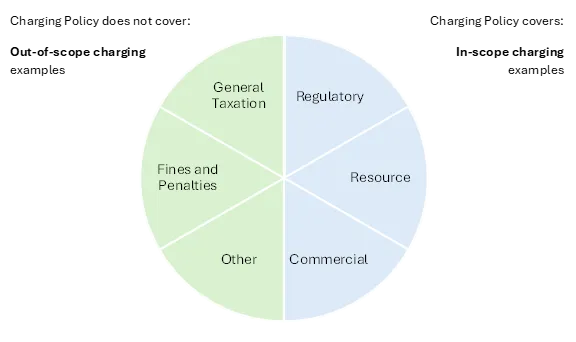
Link copied- All activities undertaken or performed by in-scope entities for the non-government sector - whether currently charged for or not - are subject to the policy, unless the activity is specifically excluded2.
- Activities of entities in-scope that are not subject to the Charging Policy and therefore excluded are:
- inter- and intra-government activities. These are transactions between Commonwealth entities or between the Commonwealth Government and Foreign, State and Territory or Local Governments. They are not in-scope unless the non-government sector creates the need for them.
- partnership activities or similar arrangements.
- activities of Commonwealth courts3 in conducting their prescribed business, including the imposition of penalties and settlements, court fees and similar fees.
- any one-off or ad hoc event, activity or service.
- investment activities that result in investment returns, interest, dividends, debt charges and related charges being paid to the Commonwealth Government.
- loan activities that result in repayments to the Commonwealth Government.
- activities that are established in response to an arrangement whereby the Government receives co-payments or co-funding.
- activities involving grants, donations or similar amounts.
- sale of assets, investments or similar capital items.
- Law enforcement, defence, and national security activities undertaken by designated law enforcement, defence, or national security entities, will usually be excluded activities. However, activities of these entities that support or are ancillary to these entities’ primary functions are in-scope activities, unless excluded.
Out-of-scope activity categories:
- Statutory marketing authority activity
- raising Custom duties or Goods and Services tax
- Commonwealth courts conducting their prescribed business, including the charging of penalties and settlements
- Inter- or intra-government activities
- Realising contractual penalties
- Investment or loan activities
- Partnership, grants, or co-funding activities
- One-off or ad hoc events
In-scope activity categories:
- Approvals
- Registrations
- Monitoring compliance
- Government Licences or permissions
- Access to public assets
- Sale of government goods or services
- Entry to institutions
Type of activity
Link copied- To guide charging, the Charging Policy establishes consistent definitions for types of in-scope activity. These definitions do not override other definitions, such as definitions for legal or accounting purposes, or those in related other policies.
- For charging purposes, in-scope activities are divided into 3 types:
- Regulatory
Regulatory activities are activities that are mandatory and imposed by law on the individuals and groups that they otherwise would not have done. There is no discretion available to the individuals or groups regarding undertaking the activity or how it must be carried out. - Resource
Resource activities involve the provision of specific rights, privileges, and access to public resources or services by the Government to individuals in the non-government sector, that only the Government may provide4. - Commercial
Commercial activities are those activities where the Government is providing products or services to individuals in the non-government sector in a market where there are actual or potential competitors5.
- Regulatory
- Resource and Commercial activity may be referred to collectively as non-regulatory activities for the purpose of this policy.
- The three types of in-scope activity result in three types of associated charging. Where a charging approach is adopted that is not as defined by the Charging Policy e.g. by a decision of government, this decision moves the charging arrangement outside the policy- Figure 3 provides examples.