
Commonwealth programs policy and approval process
For program performance related enquiries contact pgpa@finance.gov.au.
For PB Statements budgeted outcomes by programs expenses tables contact budget_framework@finance.gov.au.
On this page
This guide outlines the present requirements for Commonwealth programs that should be followed by General Government Sector (GGS) entities when determining if new programs, or changes to existing programs are required.
Commonwealth programs
Link copiedCommonwealth programs deliver benefits, services or transfer payments to individuals, industry/business or the community as a whole and are the primary vehicles for Commonwealth entities to achieve the intended results of their outcome statements.
Commencing from the 2009‐10 Budget entities were required to report to parliament by program. This is the minimum level of reporting required for budget documentation, and is recorded in the Central Budget Management System (CBMS) and reported in Portfolio Budget Statements (PB Statements). CBMS is maintained by the Department of Finance (Finance) in conjunction with entities and is used for whole‐of‐government reporting, most notably in Budget Paper No.1.
With two primary sources of program data it is vital that entities ensure consistency between CBMS and the PB Statements.
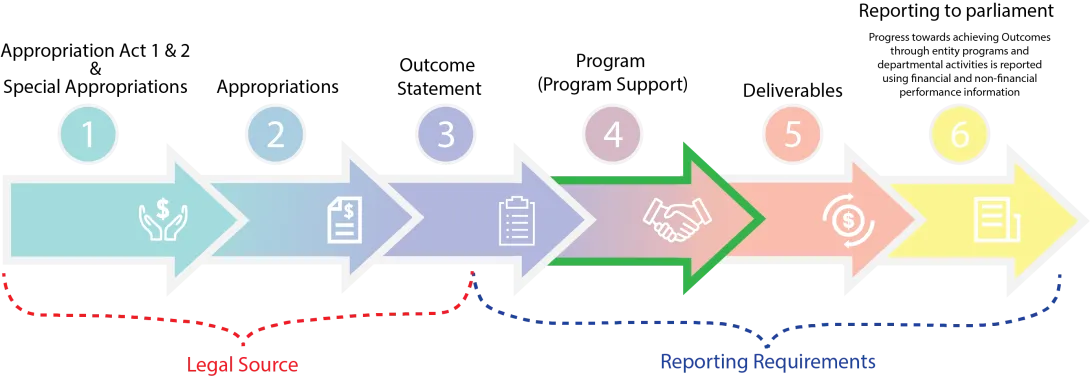
Characteristics of a Commonwealth program
Link copiedThe characteristics of Commonwealth programs are included in the hierarchy below (generally these points should apply from one to four, with point five being an exception):
Activities/group of activities that contribute to the intended results of government
- Programs should be structured around contributing to the intended results of the respective outcome statement.
- Where necessary and appropriate, groupings of existing activities (either administered or departmental) can be grouped to form a more substantial program.
Ongoing in nature (minimum span of 5 years)
Commonwealth programs are to be ongoing in nature to allow for a consistent list (CPL) at the whole of government level and for continuity in entity reporting.
Is material in size (for example > $50–100m) in annual expenditure
- Entities should use $50–100m as a guide to the minimum financial materiality of program annual expenses to ensure that the CPL remains manageable and relevant to whole of government analysis and budgeting.
- However, financial materiality is not the sole driver of entity program structures.
Maps to a single Government Financial Statistics (GFS) sub-function and single government outcome statement
- Mapping programs to a single sub function strengthens the whole-of-government medium to long-term fiscal trend information provided to government and the parliament.
- Programs are required to map to a single outcome to ensure appropriation and performing reporting frameworks are aligned.
Please see the ‘Recording of Commonwealth Programs in CBMS and the PB Statements’ section below which details some exception to these points.
Represents a particular and ongoing area of interest to the government, parliament, and/or public
- In some instances, areas of entity activity may not meet one or more of the 4 criteria outlines above, but still represent an area of activity that requires visibility, to the government, parliament or the public.
Difference between program and measure
Link copiedEntities should note that Budget measures (appearing in Budget Paper No. 2 and in the Mid Year Economic and Fiscal Outlook) rarely constitute new programs.
- Budget measures tend to be initiatives that contribute to programs (which are ongoing and material in a financial sense).
- Measures generally represent particular initiatives that contribute to a program objective.
Funding sources of programs
Link copiedAs noted above, a Commonwealth program represents activities or groups of activities that contribute to an intended result of government. As such there are no strict rules governing the composition of funding sources for a Commonwealth program. A program may by funded through one or more of a number of appropriation items (including Bill 1, Bill 2, special appropriations and special accounts) which may be administered, departmental, or a combination of the two.
Public reporting of Commonwealth programs
Link copiedEntities are required to report against the approved list of programs for which they are responsible in PB Statements, Portfolio Additional Estimates Statements and in Annual Reports from 2009‐10.
In addition to resourcing information, entities are required to provide details of the program's objects and non‐financial performance, including the deliverables and key performance indicators for each program.
Reporting below the program level
Link copiedThere may be a requirement or desire for entities to provide more detailed information on key aspects of program activities if public interest would dictate this additional level of reporting. The areas of reporting may be described as components, but in essence represent significant areas of activity and/or public interest within programs that warrant reporting to parliament.
Reporting at the program component level provides additional transparency when reporting to parliament but is not required to be separately disclosed in CBMS.
Program support
Link copiedProgram support refers to the departmental activities and resources that can be attributed to the policy development, delivery and associated costs of administering a Commonwealth program. It covers the costs of the area of the entity responsible for the program’s administration, and a relevant portion of the costs of the corporate areas that support the operation of the entity.
As program support is funded from the entity’s departmental appropriations, it is notional and can be redirected by the accountable authority of the entity to meet emerging priorities. It does, however, signal the expected resource requirements associated with the development and delivery of programs.
Program support is distinguishable from particular Commonwealth programs because it is attributable to the delivery and/or development of a specific program and is not a service or function in its own right.
Changing the Commonwealth Program List
Link copiedReasons for establishing new, or changing existing Commonwealth programs.
There are a number of circumstances that lead to the creation or refinement of Commonwealth programs, which typically include:
- the creation of a new entity, new outcome statement or new significant ongoing entity activity
- where an entity undertakes new functions that are not within existing outcomes or programs
- when government calls for the creation of a new program for reporting purposes
- where the addition of new funding or activities to an entity’s operations elevates the significance or materiality of existing program components, or
- where there are refinements to policy objectives, strategy or desired results for entity activities that result in increased prominence, dictating an ongoing and material obligation.
Approval of additions or changes to Commonwealth programs
Link copiedThe Commonwealth Program List contains all GGS entity programs, and is managed by Finance to ensure that the correct level of information is disclosed about material and significant areas of government spending.
Finance must approve proposals to change the Commonwealth Program List to ensure the usefulness and consistency of program reporting information over time.
The process for gaining formal approval for a new program, or variation to an existing program, is set out below:
- Entities should contact Finance through the relevant Agency Advice unit (AAU), providing details of proposed programs ahead of discussions on the nature of the proposed changes.
- Following officer level agreement with Finance, the entity’s Chief Financial Officer is to provide sign-off on the proposed changes to Finance (the relevant form can be found in the Knowledge Management section of CBMS or by contacting your Finance AAU).
- Following Finance approval, the program is entered into the CBMS and is included on the Commonwealth Program List.
Recording of Commonwealth programs in CBMS and the PB Statements
Link copiedThe programs reported in PB Statements must match the programs listed in CBMS, except in a limited number of cases which are detailed below. Any exceptions must be agreed with Finance prior to their inclusion or exclusion in PB Statements.
“Other” is not a Commonwealth program
Link copiedEntities are not to use the program titles “Other Administered” or “Other Departmental” in the PB Statement under any circumstances. While these categories are available in CBMS for financial allocation purposes they are not to be used for public reporting.
Entities should only use the “Other Administered” program allocation line in CBMS where absolutely necessary. This includes:
- where it is too late to create a new program in CBMS prior to the close of a whole of Government estimates update (when new funding has been agreed and no existing program is appropriate). In this situation a new program for the PB Statements must be agreed in‐principle with Finance before publication with the program to be entered into CBMS at the next available opportunity or
- where Portfolio Departments make payments within their portfolio to corporate Commonwealth entities as defined by the Public Governance, Performance and Accountability Act 2013.
Departmental funding
Link copiedEntities must not use ‘Other Departmental’ as a program in their PB Statements. ‘Other Departmental’ is generally used to record entity running costs in CBMS. In the PB Statements these costs are allocated to programs as program support.
Where departmental funding is not classed as program support, but is recorded in CBMS against ‘Other Departmental’, there are two options for entities for reporting in the PB Statements:
Roll up existing PB Statement programs into a single program
- In the 2009-10 PB Statements many entities directly converted their 2008-09 outputs into programs. In many cases these former outputs did not meet the criteria of a Commonwealth program. To ensure the consistency and comparability of the Commonwealth Program List across Government, departmental activities that do not meet the program criteria should not be separately reported as programs in the PB Statements.
- Instead these activities should be recorded as a single program containing all departmental expenses in the CBMS allocation line ‘Other Departmental’, except for program support as applicable.
- In this situation the program name must be the entity’s name to maintain consistency across Government. For example the Productivity Commission uses the CBMS program ‘Other Departmental – PC’ but for program reporting in their PB Statement uses a single program called ‘Productivity Commission’.
- If entities wish to disclose further details about their areas of work they should use the ‘program component’ section of the PB Statements.
Split programs in CBMS
- If entities wish to maintain a split of programs in their PB Statements this split must also be reflected in the CBMS.
- These programs must meet the criteria for a program detailed above.
Public reporting needs differ from the requirements of CBMS
Link copiedThere are a limited number of circumstances where the requirements of CBMS differ from the agreed Commonwealth Program List. This can occur where, for instance, a program is split over more than one sub‐function.
An example of this situation is the Finance “Public Sector Superannuation” program which is recorded as two programs in CBMS to correctly allocate data between the ‘Nominal superannuation interest’ and ‘Government superannuation benefits’ sub‐functions.
In these circumstances entities must show all lines from CBMS in their PB Statements program expenses table to enable the figures to be directly translated back to CBMS.
Commonwealth programs funded through both administered and departmental appropriations
Link copiedWhen reporting in CBMS a program must be explicitly classified as either administered or departmental because of the flow on consequences to the Appropriation Bills. This means that where a Commonwealth program reported in the PB Statements contains both administered and departmental funding (other than program support) it must be represented by two programs on CBMS. This can be done in CBMS by adding (Administered) or (Departmental) after the program name.
Guidance on classifying items as administered or departmental can be found in the Knowledge Management section of CBMS.