
Skip to main content
You're viewing a beta version of Finance.gov.au. Content is still being reviewed and updated ahead of the full launch.
Find out more about the new Finance site.
Department of Finance home
  • Careers
  • Commonwealth Climate Disclosure
  • Commonwealth Procurement Rules
  • Commonwealth Resource Management Framework
  • Graduate Data Network
  • Monthly Financial Statements
  • PGPA flipchart
  • Search Resource Management Guides
Contact
  • Budget and financial reporting
    Budget and financial reporting
    • Commonwealth Financial Statements
    • Professional support and development
    • Federal Budget
    • Managing public money
    • Financial reporting and accounting
    • Superannuation
  • Governance and risk
    Governance and risk
    • PGPA legislation, instruments and policies
    • Government bodies and governance structures
    • Climate Action in Government Operations
    • Risk and insurance
    • Regulatory reform
    • Duties and accountablity
    • Fraud and corruption control
    • Performance
    • Audit
    • Assurance reviews
  • Procurement and grants
    Procurement and grants
    • Procurement
    • Commonwealth grants
  • Property and investments
    Property and investments
    • Property and construction
    • Investments
  • Digital and data
    Digital and data
    • Data and Digital Ministers Meeting
    • Whole of government ICT and digital services
    • Managing public data
    • Service Delivery Office
    • Digital ID system
    • Ministerial and Parliamentary Services
  • About us
    About us
    • Our executive
    • Ministers
    • Careers
    • News and media
    • Newsletters
    • Events and training
    • Publications
    • Consultations
    • Access to information
    • Freedom of information
    • Contact
    • Corporate reporting
    • Using the site
    • Budget and financial reporting
    • Commonwealth Financial Statements
    • Professional support and development
    • Federal Budget
    • Managing public money
    • Financial reporting and accounting
    • Superannuation
    • Governance and risk
    • PGPA legislation, instruments and policies
    • Government bodies and governance structures
    • Climate Action in Government Operations
    • Risk and insurance
    • Regulatory reform
    • Duties and accountablity
    • Fraud and corruption control
    • Performance
    • Audit
    • Assurance reviews
    • Procurement and grants
    • Procurement
    • Commonwealth grants
    • Property and investments
    • Property and construction
    • Investments
    • Digital and data
    • Data and Digital Ministers Meeting
    • Whole of government ICT and digital services
    • Managing public data
    • Service Delivery Office
    • Digital ID system
    • Ministerial and Parliamentary Services
    • About us
    • Our executive
    • Ministers
    • Careers
    • News and media
    • Newsletters
    • Events and training
    • Publications
    • Consultations
    • Access to information
    • Freedom of information
    • Contact
    • Corporate reporting
    • Using the site
    • Careers
    • Commonwealth Climate Disclosure
    • Commonwealth Procurement Rules
    • Commonwealth Resource Management Framework
    • Graduate Data Network
    • Monthly Financial Statements
    • PGPA flipchart
    • Search Resource Management Guides
Contact

Breadcrumb

  1. Home
  2. Budget and financial reporting
  3. Managing public money
  4. RMG 413 Banking and managing Consolidated Revenue Fund money
  5. Central banking and cash management

Central banking and cash management

Supports Commonwealth entities in meeting requirements for banking, cash management and Consolidated Revenue Fund (CRF) money administration.
Last updated: 3 September 2026 
Email
View all RMGs
RMG 413 Banking and managing Consolidated Revenue Fund money
  • Appropriations and cash
  • Bankable money
  • Central banking and cash management
  • Introduction and legislative framework

On this page

Are you uploading, updating or amending a Resource Management Guide or PGPA related guidance? If yes please contact PGPA@finance.gov.au .

Central banking

Link copied

The Commonwealth’s central bank account, under subsection 53(3) of the Public Governance, Performance and Accountability Act 2013 (PGPA Act), must be maintained with the Reserve Bank of Australia (RBA).

Central banking includes managing the daily consolidation of Australian Government cash in the Official Public Account (OPA) and transferring cash from the OPA to entity bank accounts.

The RBA provides a facility to manage the OPA Group, the aggregate balance of which represents the Commonwealth's daily cash position. Finance manages this facility on behalf of the Australian Government.

Central cash management

Link copied

Central cash management involves the overnight consolidation and investment of whole of government bank account balances, including the bank account balances of all non-corporate Commonwealth entity (NCEs) and specific corporate Commonwealth entity (CCEs). Through this process, government funds are consolidated each night in the OPA Group, which includes the OPA (central bank account).

Under the Finance Minister’s Delegations (Schedule 1: Part 1: Division 2 Paragraph 1.3), any agreements between Commonwealth entities and their transactional banks must have processes in place to ensure all Commonwealth cash in Australia be consolidated each day within the OPA held with the RBA. This includes compliance with specific sweeping, transfer and reporting requirements as set out in the Commonwealth banking agreement between the Australian Government (represented by Finance) and authorised transactional banks. 

The diagram below illustrates the cash flow connectivity between NCE bank accounts, the OPA, the RBA and the Australian Office of Financial Management (AOFM). 
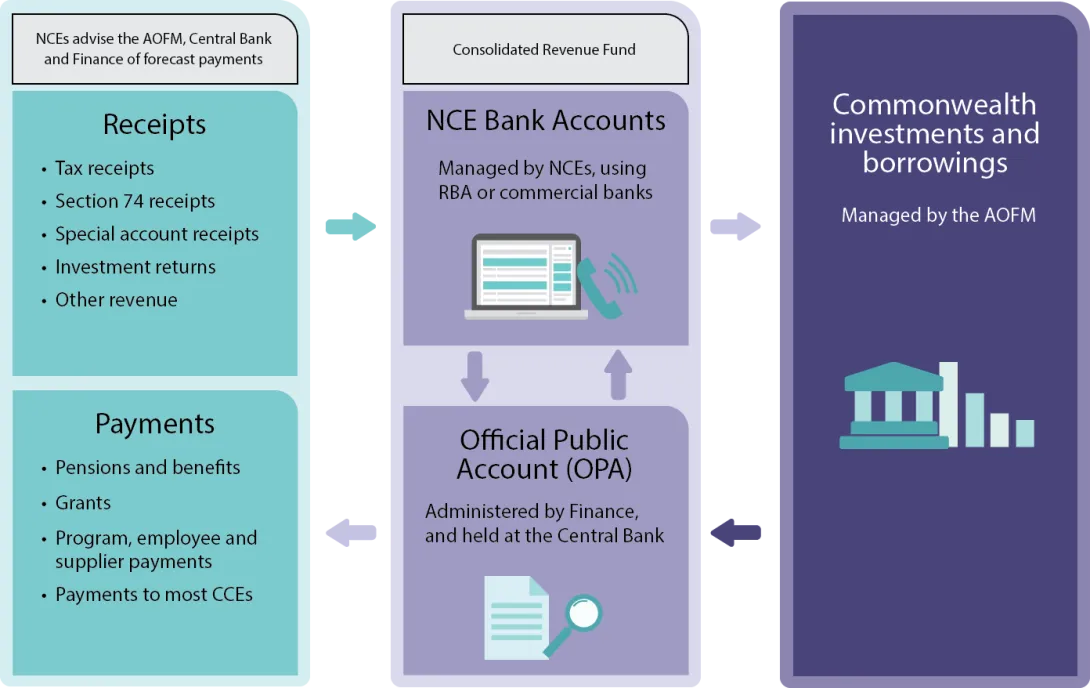
Commonwealth cash management flow showing how government receipts are collected through NCE bank accounts and the Official Public Account, supported by Commonwealth investments and borrowings, and used to make government payments.

Central cash management roles

Link copied

The following entities have central cash management roles:

  • The AOFM, in the Treasury portfolio, is responsible for ensuring the government’s cash needs are met and is required, by ministerial direction, to maintain a cash balance in the OPA Group. The AOFM achieves this by:
    • managing government debt and investment
    • issuing Treasury bonds and Treasury notes to fund the government’s cash needs
    • investing cash in short-term investments.
  • Finance transfers amounts from the OPA at the request of entities (and in compliance with the Appropriation Acts) to their transactional bank accounts, to meet their cash requirements. Finance also monitors the implementation of related government policies.
  • The RBA oversees the Australian payments system, which encompasses a wide variety of individual payment methods. These methods include electronic funds transfer between bank accounts, payment cards, cheques and high-value corporate payments.

All entities manage cash to make payments and receipt cash they receive. Bank accounts are used to manage payments and receipts.

Interbank cash transfers

Link copied

The RBA maintains the OPA and also:

  • holds Exchange Settlement Accounts (ESA) for authorised deposit-taking institution (ADIs)
  • owns and operates the Reserve Bank Information and Transfer System (RITS) through which transactions across ESAs occur.

When an entity maintains a bank account with an ADI other than the RBA, a cash transfer between that ADI’s ESA and the RBA’s ESA is an interbank cash transfer. Interbank payment obligations in Australia are settled using RITS.

RITS payments are settled on a real-time gross settlement basis, with processing and settlement taking place in real time (continuously).

Central Budget Management System

Link copied

The Central Budget Management System (CBMS) is used to manage the flow of financial information between Finance and entities to facilitate cash and appropriation management, the preparation of budget documentation and financial reporting.

Finance transfers money from the OPA to the entity’s bank account. 

For cash to be made available to an entity, the entity must submit a request in CBMS for cash against a specific appropriation.

Policies, legislation and guidelines

Link copied

Public Governance, Performance and Accountability Act 2013
Finance Minister’s Delegations

Glossary

Link copied

Appropriation
Australian Government
Central Budget Management System
Commonwealth
Corporate Commonwealth entity
Entity
Investment
Non-corporate Commonwealth entity
Official Public Account

Relevant sections of the PGPA Act and Rule

Link copied

PGPA Act

  • Section 53

What are you looking for?

Popular searches:

  • Careers
  • Commonwealth Contracting Suite
  • Commonwealth procurement rules
  • PGPA Act Flipchart
  • Publications
Department of Finance home
Recognising 50 years of service 1976–2026
  • Careers
  • Events and training
  • Freedom of Information
  • Contact
  • Accessibility
  • Disclaimer
  • Copyright
  • Privacy
  • Ministers
  • Selling to Gov
  • Digital ID
  • Australian Political Exchange
  • Election Costings

The Department of Finance acknowledges the Traditional Owners and Custodians throughout Australia and their continuing connection to land, water and community.

© Commonwealth of Australia 2026 | ABN 61970 632 495