
Regulatory Policy, Practice and Performance Framework and resources
On this page
The Australian Government has developed the Regulatory Policy, Practice & Performance (RPPP) Framework to drive modern, fit-for-purpose regulation in a digital era.
The RPPP Framework sets out 6 principles to guide Commonwealth regulators and regulatory policymakers in designing and delivering effective and efficient regulation. Fit-for-purpose regulation can improve productivity, support economic growth, and strengthen trust in regulatory systems.
The principles are:
- targeted and risk-based
- integrated in existing systems
- user-centred
- evidence-based and data-driven
- reflective of the digital era
- continuously improved and outcomes-focused.
Commonwealth regulators and regulatory policymakers are expected to apply the RPPP Framework principles across the regulatory life cycle.
The regulatory life cycle is an approach to designing, managing, and reviewing regulation and regulatory systems. It supports continuous improvement to keep them fit for purpose.
While policymakers and regulators have different roles in the regulatory life cycle, their work is often closely connected and supports shared regulatory objectives.
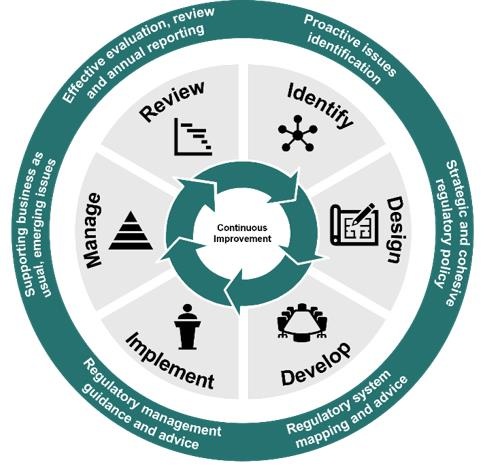
The regulatory life cycle has 6 stages that form a continuous cycle:
- Identify – Proactive issues identification.
- Design – Strategic and cohesive regulatory policy.
- Develop – Regulatory system mapping and advice.
- Implement – Regulatory management guidance and advice.
- Manage – Supporting business as usual, emerging issues.
- Review – Effective evaluation, review and annual reporting.
At its core is continuous improvement.
Supporting tools and resources
Link copiedThe Department of Finance is developing tools and resources to help agencies embed the RPPP Framework. These tools and resources turn principles to practical action. They support regulators and policymakers to deliver effective, fit-for-purpose regulation for Australia now and in the future.
Guidance for policymakers and regulators
The below guidance and tools help regulatory policymakers and regulators apply better practice across the regulatory life cycle.
Regulator performance resources
Effective regulator performance supports public confidence and delivery of high-quality regulatory outcomes. All Commonwealth policymakers and regulators should follow guidance on regulator performance reporting, developing standards and conformance policy to demonstrate transparency, accountability and a commitment to continuous improvement.
Regulator capability resources
Uplifting regulator capability helps strengthen whole-of-government regulatory policy, practice and performance. Regulators should take a holistic approach to aligning and improving enterprise level and staff level regulator capability.
More information
Link copiedFor more information about the framework and supporting tools, contact rpppframework@finance.gov.au.