
Contract end dates
On this page
Setting contract end dates
Link copiedThe end date of a contract does not necessarily have to be the date of final delivery of the goods or services. When setting a contract end date, amongst other things, officials may consider:
- business requirements, including budget
- changing market conditions (price volatility, likelihood of new entrants, technology, innovation)
- the potential for changes to government positions or policy.
The end date should provide for a period of time after the final delivery to allow for the issue and payment of final invoices, to tidy up other contract management issues, and allow time for implementation of any subsequent arrangements, if needed.
Extension options provide flexibility for entities when determining if the agreement should continue past its initial term. An extension option is a legal right within a contract for one of the parties to extend the term of the contract for a specified period. It is usual for Commonwealth standard contracts to provide that exercising an extension is at the Commonwealth's discretion.
Contracts without a fixed end date
Link copiedSome contracts may not have a fixed end date (for example some software licences), while other contracts may end following specific achievements or milestones (for example construction contracts).
Factors relevant to a procurement, such as the business requirement, prices and technology, may change over time. Paragraph 4.16 of the CPRs states that when a contract does not specify an end date it must allow for periodic review and subsequent termination of the contract, if the relevant entity determines that it does not continue to represent value for money.
Entities are encouraged to establish review procedures commensurate with the scale, scope and risk of the procurement, allowing them to be satisfied that a contract will continue to achieve value for money. Key performance indicators may assist in this process.
Deciding whether to extend a contract
Link copiedWhen deciding whether to exercise an extension option or extend a contract by variation, officials are encouraged to consider the costs and benefits in continuing with the current contract, including:
- whether extending the contract would continue to provide value for money
- whether reapproaching the market would result in a better outcome, having regard to potential costs involved
- the performance of the current provider(s)
- whether there will be sufficient time to run a new procurement process
- the current market conditions
- the changing needs/requirements of entities.
The diagram below provides an example of when decisions affecting the length of a contract should ordinarily be made during the life of a three-year contract which has two extension options each one year in length. This timeline varies based on the complexity of the procurement.
In the example:
- exercising the first extension option is considered approximately two-thirds of the way between years 2 and 3.
- exercising the second extension option is considered approximately two-thirds of the way between years 3 and 4.
- shortly after the beginning of the 4th year, a new procurement commences.
- near the end of the 4th year, the contract should be extended if necessary.
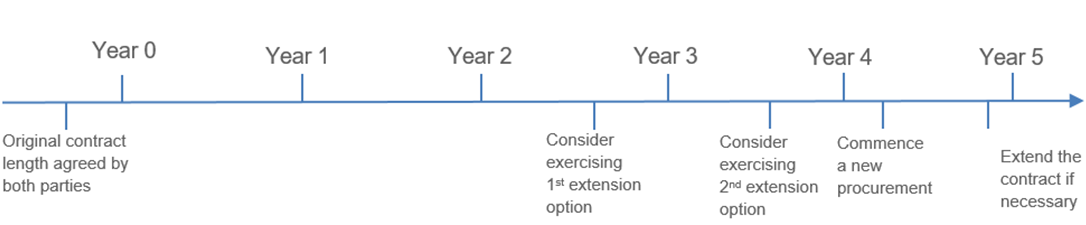
Exercising an extension option
Link copiedAn extension option must be exercised in accordance with the terms of the contract. This can, for example, be achieved by notifying the other party of the intention to exercise the option within a certain period of time. In exercising an option, officials are encouraged to consult with stakeholders, gather relevant information, and conduct an appropriate value for money assessment, obtaining necessary approvals from delegates in accordance with the PGPA framework and internal requirements.
Extension options should not solely be exercised due to failure to appropriately plan procurement needs, continue supplier relationships, or with the intention of discriminating against a supplier or avoiding competition.
Extending a contract through variation
Link copiedAny variation to a procurement contract should not significantly change the scope of the contract. The same principle applies when varying a contract to extend its initial term. It is for the relevant delegate to determine whether a variation is significant. As a general rule, contracts should only be extended for the length of time that will allow for the procurement and/or implementation of a subsequent arrangement (if needed), or provision of all deliverables under the original contract. For example, a contract extension may be appropriate to complete a protracted procurement process and transition to a subsequent arrangement for goods and/or services.
A contract would ordinarily be varied consistent with the procedures set out in the contract itself and/or specific entity procedures. Importantly, the variation should be in writing and should be agreed to by all parties to the contract for it to have legal effect.
Entities should only extend a contract where necessary. Extending a contract via a variation may not result in a value for money outcome because a supplier may be unwilling to continue to supply its goods and services, and/or the continued terms of supply may be unfavourable. Entities are therefore encouraged to not rely upon the ability to extend a contract by variation.
Contracts should not be extended by variation due to a failure to appropriately plan procurement needs, continue supplier relationships, or with the intention of discriminating against a supplier, avoiding competition, or to avoid obligations under the CPRs.