
Acquisition
On this page
Overview
Link copiedThe Lands Acquisition Act 1989 (LAA) establishes the legal basis for the Commonwealth to acquire interests in land. Acquisitions must be for a public purpose, be undertaken on just terms and be authorised under the LAA.
The LAA provides for different acquisition pathways depending on the circumstances of the proposed interest in land, including acquisition by agreement, compulsory acquisition, and acquisitions involving specific types of land such as public parks, overseas land and leasehold interests.
An acquisition will involve:
- identifying the public purpose for which the interest in land is required
- developing an acquisition strategy
- confirming approvals and delegations
- undertaking due diligence and valuation activities
- managing the acquisition by agreement, with responsibility resting with officials of the acquiring entity
- considering compulsory acquisition if acquisition by agreement is not viable
- completing the acquisition and any associated compensation arrangements
- reporting and recordkeeping obligations.
Key acquisition principles
When acquiring an interest in land, officials must ensure the acquisition:
- is for a public purpose
- is undertaken on just terms
- represents value for money
- uses public resources in an efficient, effective, economical and ethical manner
- is consistent with principles of transparency, accountability, ethics and probity
- complies with relevant legislative and policy requirements.
Just terms
Link copiedIf the entity is acquiring land under the LAA, the amount paid for an acquisition by agreement or through compulsory means needs to satisfy ‘just terms’ for the landholder and, as the acquisition is a procurement, must also represent an appropriate use of resources and provide value for money for the Commonwealth.
An appropriate use of resources means that land transactions are managed in an efficient, effective, economical and ethical way, consistent with the accountable authority’s obligations under the PGPA Act.
Where a price is mutually agreed between the Commonwealth and the landholder, it is important that delegated officials can clearly demonstrate both value for money and just terms have been achieved.
In cases where the landholder is seeking a price above what is anticipated, officials are required to consult with Finance at LAA@finance.gov.au.
Value for money
Link copiedOfficials must be satisfied that acquisitions represent value for money. In considering value for money, officials, noting the Commonwealth Procurement Rules (CPRs), should consider the relevant financial and non-financial costs, benefits, risks and broader policy considerations of the acquisition.
The LAA does not prescribe how terms and price should be determined for an acquisition by agreement. When negotiating with a landholder, officials should be able to demonstrate how the agreed outcome is consistent with value for money, the proper use of public resources and any applicable requirements relating to just terms, including consistency with principles of transparency, accountability, ethics and probity.
Acquisition by agreement
Link copiedAcquisition by agreement occurs when terms and price are mutually agreed by the Commonwealth and the interest holder ahead of the acquisition.
The interest holder must agree to the acquisition and both parties enter a contract that sets a mutually agreed price.
Acquisitions by agreement are the Commonwealth’s preferred approach, where they represent value for money for the Commonwealth. Where appropriate, officials are encouraged to acquire an interest in land by agreement before pursuing a compulsory acquisition.
Note: Certain acquisitions by agreement must be formally reported in the Parliament. See Reporting obligations for more information.
Conditions for an acquisition by agreement
The acquisition must be for a public purpose and meet one of the following conditions.
Under section 40(5) of the LAA, an interest will be taken to be available in the market if one of the following applies:
- the interest in land is advertised as being available for sale or lease, listed with a real estate agent or offered in response to a publicly advertised request, or
- the acquisition is certified by the Finance Minister (or delegate) under section 40(6) as being a standard commercial transaction.
This means that the Finance Minister (or delegate) is satisfied that the acquisition would amount to a normal commercial transaction between parties dealing with each other on equal terms. Officials should obtain advice from Finance in relation to the level of delegation required. Forms are available on the Information to support the Lands Acquisition Act 1989 page.
See Guidance to assist delegates in considering whether to exercise the Minister's right to issue a certificate under section 40(6) of the LAA.
A Pre-Acquisition Declaration (PAD) has been issued under section 22 of the LAA and has become absolute and is in force. It is usually the first step in a compulsory acquisition process and can also be the first step in an acquisition by agreement process.
PADs may only be made by the Finance Minister or a Finance delegate and are subject to the tabling requirements for acquisitions, see Parliamentary reporting.
A PAD is subject to reconsideration and review rights for any person affected by it.
In circumstances where land is required urgently the Finance Minister may refer to section 24 of the LAA and where the Minister is satisfied the conditions are met then they can issue a section 24 certificate in respect of the acquisition.
A section 24 certificate is used in circumstances where there is an urgent necessity for the acquisition and it would be contrary to the public interest to delay acquisition. Additionally, it can be used where a PAD in respect of the proposed acquisition would result in a disclosure of information that would be prejudicial to the security, defence or international relations of Australia. Section 24 certificates are rarely used and may only be made by the Finance Minister and are subject to the tabling requirements for acquisitions, see Parliamentary reporting.
If the interest is owned by the Commonwealth or a Commonwealth authority, officials may enter into an agreement for the acquisition of the interest.
Note: Consistent with Conditions 2 and 3, Condition 4 is subject to the tabling requirements for acquisitions, see Parliamentary reporting.
Public purpose acquisition chart
Link copied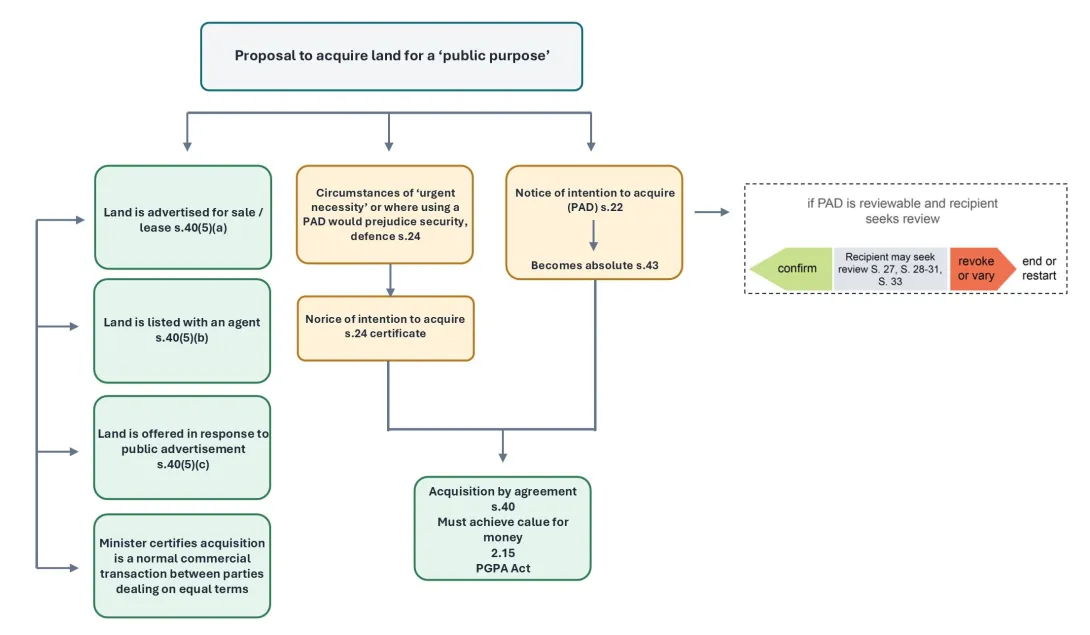
Market availability and price considerations
When an interest in land is available in the market within the meaning of subsection 40(5), the price agreed with the landholder for the acquisition of the interest in land should be the market price.
If an interest in land is not ‘available in the market’ under subsection 40(5) of the LAA, officials may consider the market price and other factors when determining the acquisition price. This can include situations where the interest is not advertised for sale. Officials should document their approach and ensure the pricing decision is transparent, ethical, on just terms and consistent with the proper use of public resources under the Public Governance Performance and Accountability Act 2013 (PGPA Act).
If an acquisition cannot be authorised under an entity’s LAA delegations, for example where the interest is not available in the market within the meaning of subsection 40(5) of the LAA, officials should engage with Finance and refer to the Guidance to assist delegates.
Landholder information and support
Officials should, where circumstances allow, provide landholders with clear information about the acquisition process before negotiations commence. Negotiations may occur before or after a PAD becomes absolute, or the Finance Minister gives a section 24 certificate. Throughout the process, officials should seek to ensure landholders are informed and able to engage meaningfully in negotiations.
Officials should use best-practice engagement approaches to support the landholder to reach mutual agreement on the terms and price. At a minimum, this information should cover:
- why the interest in land is required
- what the acquisition by agreement process involves
- the rights and duties of those affected
- an indicative timetable of events
- whether the interest is owned by the Commonwealth or a Commonwealth authority
- how the LAA applies to the acquisition or disposal of an interest in land by an entity as defined in the LAA.
Compulsory acquisition
Link copiedCompulsory acquisition may be considered where acquisition by agreement is not possible or is not appropriate in the circumstances, such as the acquisition of a public park. Compulsory acquisition is a significant exercise of Commonwealth power and must be undertaken in accordance with the LAA. Section 51(xxxi) of the Constitution gives the Australian Government the power to compulsorily acquire privately owned land to use for projects that are within the governments areas of responsibility. Examples of this include the development of public works and infrastructure such as a meteorological station. The government cannot compulsorily acquire land for reasons outside of the areas covered by the Constitution.
Officials should engage with Finance as early as practicable when considering a compulsory acquisition. Several steps in the compulsory acquisition process may only be undertaken by the Finance Minister or a Finance delegate.
Role of officials
Officials are responsible for:
- obtaining support from their portfolio minister to proceed with the compulsory acquisition process
- developing and implementing the acquisition strategy
- engaging with landholders and other affected interest holders
- undertaking due diligence activities and obtaining relevant valuations
- working with Finance throughout the acquisition process
- funding the acquisition and any compensation payable
- reporting and recordkeeping requirements.
The relevant portfolio minister should write to the Finance Minister seeking agreement to proceed with a compulsory acquisition.
Role of Finance
Finance supports and administers compulsory acquisitions under the LAA. This includes:
- advising officials on compulsory acquisition requirements
- supporting the Finance Minister in exercising powers under the LAA
- managing acquisition steps that may only be undertaken by the Finance Minister or a Finance delegate
- working with officials on compensation matters
- administering reporting and parliamentary requirements.
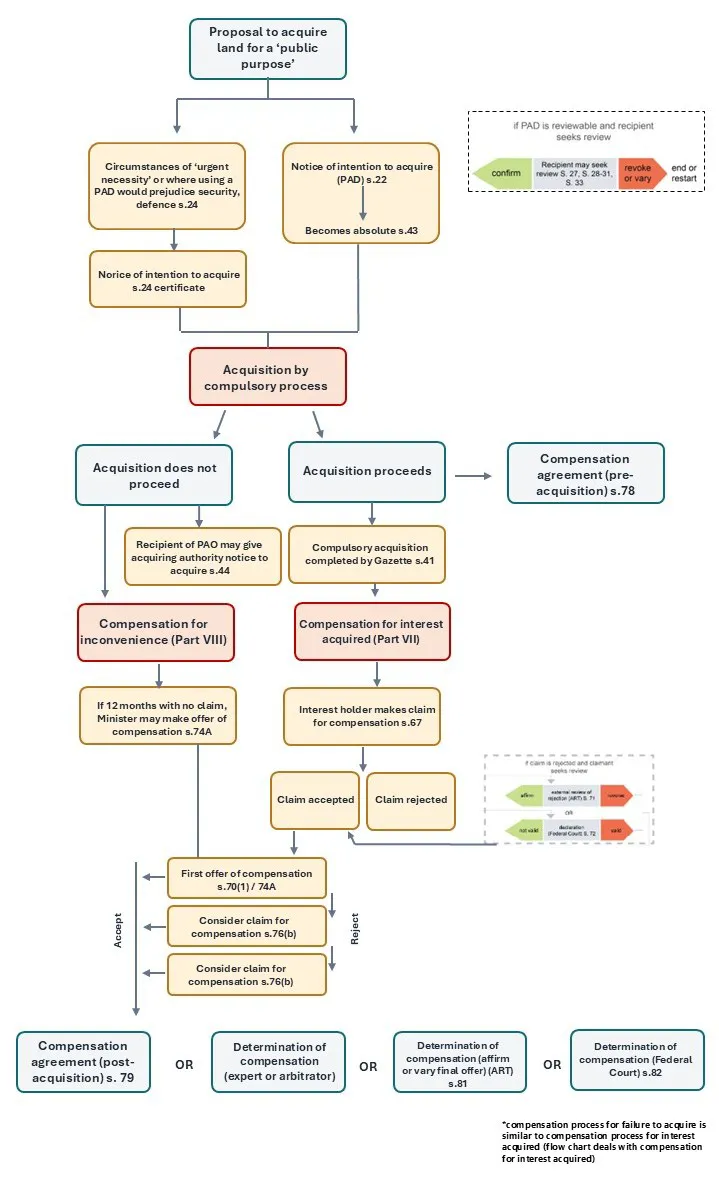
Compensation pathways
Affected landholders are entitled to compensation that, having regard to all relevant matters, justly compensates them for the acquisition.
Officials should identify the proposed compensation approach during planning and document it in the acquisition strategy.
Agreement before acquisition
Compensation may be negotiated and agreed before acquisition under section 78 of the LAA. Negotiations are managed by the official and decision-maker in consultation with Finance. The Finance Minister or a Finance delegate executes the agreement on behalf of the Commonwealth.
Agreement after acquisition
- Compensation may be agreed after the acquisition has occurred. Finance manages the process in consultation with the official. The decision-maker remains responsible for funding and administering compensation payments.
- See Compensation for further information.
Special acquisition circumstances
Link copiedCertain acquisitions involve additional legislative requirements, approvals or procedural considerations beyond those that apply to a standard acquisition. Officials should identify these circumstances early in the planning process and engage with Finance where appropriate.
This section outlines specific requirements relating to:
- acquisitions of interests in land in public parks
- acquisitions and disposals involving overseas land
- leasing transactions as interests in land under the LAA.
Where a transaction falls within one of these categories, officials should ensure the acquisition strategy addresses any additional approvals, reporting obligations, stakeholder engagement requirements and timeframes that may apply.
Public parks
Link copiedAn interest in land in a public park may only be acquired through a compulsory acquisition under the LAA.
The LAA requires that officials must obtain the consent of the relevant state or territory government when compulsorily acquiring land in a public park. For this reason, officials should be aware that project timeframes to acquire land in a public park can be lengthy.
Where an acquisition involves land in a public park, officials should consult with Finance during the planning stage. Early engagement enables Finance to advise on factors to consider when developing the acquisition strategy and to provide early visibility of the acquisition to the Finance Minister.
Before commencing negotiations, an official should obtain legal advice to confirm whether the interest in land is a public park for the purposes of the LAA. If it is not, the advice should identify the acquisition process that applies. Valuation expertise may also be required to support the acquisition.
In developing an acquisition strategy, officials should have regard to the compensation provisions under the LAA, which provide an alternative method for determining market value in circumstances where the claimant intends to purchase replacement park land.
Officials should contact Finance at LAA@finance.gov.au for further information.
Overseas land
Link copiedThe acquisition and disposal of an interest in overseas land by officials is also subject to the LAA (see section 125) and additional overseas acquisition reporting requirements. Examples of interests in overseas land include Australian embassies and residences for posted staff.
Unless an exemption applies, written approval from the Finance Minister or an appropriate delegate within an entity or in Finance is required before a decision-maker can authorise the acquisition or disposal of an interest in overseas land.
See Delegations for more information.
Leasing transactions
Link copiedLeases are an interest in land under the LAA. Leasing transactions involve officials exercising LAA acquisition or disposal delegations, under powers delegated by the Finance Minister. The LAA obligations are in addition to applicable requirements under the Commonwealth Property Management Framework (CPMF), including the Lease Review Process (LRP).
Compliance with both the LAA and CPMF is required before a binding agreement comes into existence.
Officials must not enter into a binding agreement until authorisation under the LAA has been granted and Finance has advised the outcome of the lease notification or endorsement process.
Officials should consult early with Finance if the transaction will require non-routine advice on the interpretation of the LAA, or an approval by the Finance Minister (or Finance delegate).
For example, a disposal by grant of a lease with a term more than 30 years (including extension options) requires the approval of the Finance Minister or a delegate within Finance.
For other circumstances where a proposed lease is not supported by delegation to the entity under the LAA delegations (for example, the lease is not available in the market within the meaning of section 40(5) of the LAA and the proposed term exceeds 30 years (including extension options)), officials are required to engage Finance early.
Email Finance at LAA@finance.gov.au to consult on these matters.
See Delegations for standard words on seeking delegate approval for leasing.
Support for leasing arrangements
Link copiedOfficials should engage with Finance and their Property Service Provider (PSP) as early as possible with respect to leasing proposals. In planning a new lease, officials should work with their PSP to determine whether the lease proposal will be subject to the notification or endorsement process in accordance with the CPMF.
For further information on the lease endorsement and notification process, please refer to the CPMF and RMG 500.
Authorisations
Link copiedOfficials who do not have the appropriate delegations within their entity must submit an Authorisation of Property Lease or Licence form to Finance for authorisation prior to entering the proposed arrangement. Please allow at least 5 working days for Finance to process your form.
Officials who hold appropriate delegations may choose to use the form or incorporate similar wording into delegate briefing or approval documents.
Policies, legislation and guidelines
Link copied- The Constitution
- Auditor-General Act 1997
- Public Service Act 1999
- Crimes Act 1914
- Public Governance, Performance and Accountability Act 2013
- Lands Acquisition Act 1989
- Lands Acquisition Act 1955 (for preserved mining provisions)
- Lands Acquisition Regulations 2017
- Lands Acquisition 1989 Delegation Instrument
- Commonwealth Property Disposal Policy
Resource Management Guides
Link copiedTools and templates
Link copiedGlossary
Link copied- Accountable Authorities
- Assigning a lease
- Australian Government Property Register (AGPR)
- Budget Process Operational Rules
- Budget Process Operational Rules (BPORs)
- Capital Management Plan (CMP)
- Capital Works
- Chief Financial Officer (CFO)
- Commonwealth authority
- Commonwealth National Lease (CNL)
- Commonwealth Procurement Rules (CPRs)
- Contract Notice (CN)
- Corporate Commonwealth entity
- Cost Benefit Analysis
- Department of Defence (Defence)
- Department of Finance (Finance)
- Detailed Business Case (DBC)
- Embodied Emissions
- Entity
- Expediency motion
- Fit-out
- Goods and Services Tax (GST)
- Greenhouse Gas (GHG)
- Heads of compensation
- Initial Business Case (IBC)
- Landholder
- Lands Acquisition Act 1989 (LAA)
- Lease
- Lease Endorsement
- Lease Notification
- Leasing Strategy
- Local Impact Assessment
- Memorandum of Understanding (MoU)
- New Policy Proposal (NPP)
- Non-corporate Commonwealth entity
- Occupational Density Target
- Official
- P50 / P80
- Parliamentary Standing Committee on Public Works/Public Works Committee (PWC)
- Property
- Property Management Plan (PMP)
- Property Operating Expenses (POE)
- Property Service Provider (PSP)
- Property Services Coordinated Procurement (PSCP) Arrangements
- Public Governance, Performance and Accountability Act 2013 (PGPA Act)
- Public Works
- Public Works Committee Act 1969 (PWC Act)
- Real Property
- Referral motion
- Resource Management Guide (RMG)
- Statistical Area level 2 (SA2)
- Strategic Property Adviser (SPA)
- Surrendering a lease
- Two Stage Capital Works Approval Process
- Value for money
- Whole of Government Leasing Strategy (Leasing strategy)
- Whole-of-Life Costs (WoLC)
- Work Package
- Work-point