Delivery vehicles
On this page
This toolkit item relates to Part 2 - Investment governance, funding and financing of the Commonwealth Investments Resource Management Guide.
Delivery vehicles refer to management and governance structures the government establishes to deliver investments. Delivery vehicles complement investment instruments, which determine the government’s financing approach of investments. Different combinations of delivery vehicles and investment instruments offer varying degrees of government control and exposure to both project and financial risks.
The appropriate delivery vehicle will be informed by the objective of the investment proposal and resultant asset. Exhibit 1 below provides a table of the most common delivery vehicles to achieve particular objectives, and provides a link to detailed resources on each option.
Exhibit 1: Detailed information available to inform selection of delivery vehicles
Requirements of the Governance Policy need to be applied to determine appropriate governance structure. For further information on these requirements, contact PGPA and refer to the guidance on the website.
| Objective | Delivery vehicle category | Resource |
|---|---|---|
|
Make recurring investments for a purely financial outcome
|
Investment Fund
|
|
|
Make recurring investments for a policy and financial outcome |
Specialist Investment Vehicle
|
|
|
Undertake a business |
Government Business Enterprise (Corporate Commonwealth Entity or a Commonwealth Company) |
|
|
Cth. Controlled operations (not a business) with separate legal personality under the Corporations Act |
Other Commonwealth Companies |
|
|
Cth. Controlled operations with separate legal personality and degree of independence from the Government) |
Other Corporate Commonwealth Entities |
|
|
Another objective with the Commonwealth only |
Non-corporate Commonwealth entities |
|
|
Another objective, including with external parties |
Other governance relationships |
Commonwealth legal and governance structures
Link copiedDifferent types of legal and governance structures are utilised to implement government policies, deliver services and achieve policy objectives. The Commonwealth Governance Structures Policy supports determining the fit-for-purpose governance structure for new government activities. Read more about the mandatory requirements of the governance policy. The government uses a range of governance structures to deliver government activities.
For example, the following 3 types of governance structures are subject to the PGPA Act and are categorised as primary bodies when applying the Governance Policy.
Non-corporate Commonwealth Entity (NCE)
Commonwealth entities that are legally and financially part of the Commonwealth.
Corporate Commonwealth Entity (CCE)
A body corporate that has a separate legal personality from the Commonwealth and can act in its own right exercising certain legal rights such as entering into contracts and owning property.
Commonwealth Company (CC)
A company established under the Corporations Act 2001 that the Commonwealth controls. A Commonwealth company is legally and financially separate from the Commonwealth.
PGPA Flipchart
The Flipchart of PGPA Act Commonwealth entities and companies (PGPA Flipchart) lists each Commonwealth entity and company by portfolio. Further guidance on Commonwealth bodies is available in the Commonwealth Governance Structures Policy and types of Australian Government Bodies.
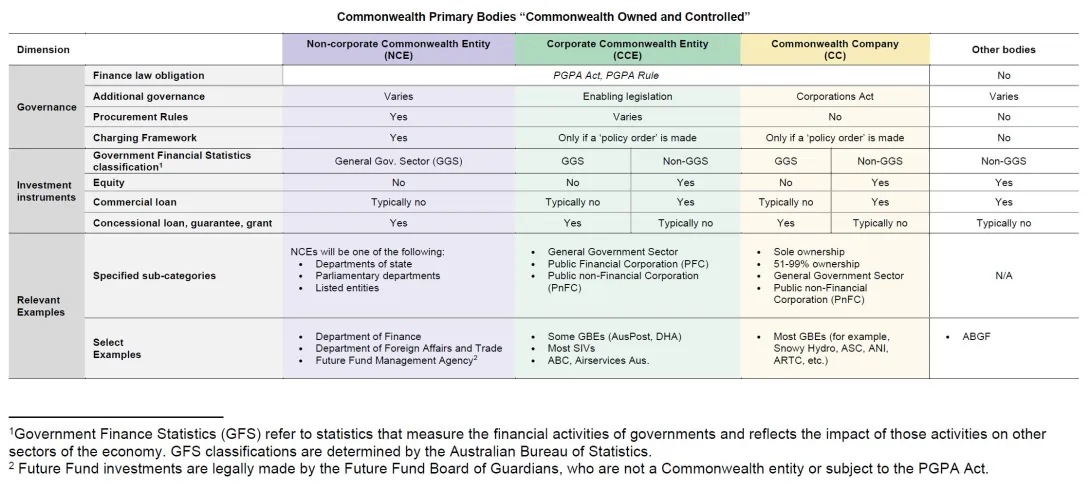
All proposals to create a primary or secondary statutory body must be assessed against the mandatory requirements of the Governance Policy. Exhibit 2 below summarises some of the key aspects of each of these bodies.
Exhibit 2: Characteristics of delivery vehicles
Selection of a delivery vehicle should be determined by the nature, operations and the proposed level of Government involvement and must be assessed against the mandatory requirements of the Commonwealth Governance Structures Policy. The characteristics of a delivery vehicle should be considered when determining the appropriate vehicle.